Pearson+ LogoPearson+ Logo
Ch.10 Acids and Bases and Equilibrium
Timberlake - Chemistry: An Introduction to General, Organic, and Biological Chemistry 13th Edition
Timberlake13th EditionChemistry: An Introduction to General, Organic, and Biological ChemistryISBN: 9780134421353Not the one you use?Change textbook
Chapter 10, Problem 1e

Indicate whether each of the following statements is characteristic of an acid, a base, or both
e. is an electrolyte

Verified step by step guidance
1
Understand the term 'electrolyte': An electrolyte is a substance that dissolves in water to produce ions, allowing the solution to conduct electricity.
Recall the properties of acids: Acids are substances that release hydrogen ions (H⁺) when dissolved in water, making them electrolytes.
Recall the properties of bases: Bases are substances that release hydroxide ions (OH⁻) when dissolved in water, also making them electrolytes.
Recognize that both acids and bases can act as electrolytes because they dissociate into ions in aqueous solutions.
Conclude that the characteristic of being an electrolyte applies to both acids and bases, as both can conduct electricity when dissolved in water.

Verified video answer for a similar problem:

This video solution was recommended by our tutors as helpful for the problem above.
Video duration:
1m
Was this helpful?

Key Concepts

Here are the essential concepts you must grasp in order to answer the question correctly.

Electrolytes

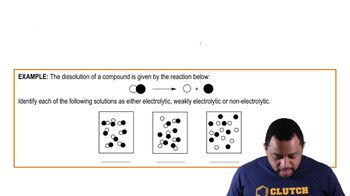
Electrolytes are substances that dissociate into ions when dissolved in water, allowing the solution to conduct electricity. Both acids and bases can act as electrolytes because they release ions into the solution. For example, hydrochloric acid (HCl) dissociates into H+ and Cl- ions, while sodium hydroxide (NaOH) dissociates into Na+ and OH- ions.
Recommended video:
Guided course
01:07
Electrolytes (Simplified) Example 3

Acids

Acids are substances that can donate protons (H+) in a chemical reaction. They typically have a sour taste and can turn blue litmus paper red. Acids, when dissolved in water, increase the concentration of H+ ions, making the solution acidic. Common examples include citric acid and sulfuric acid.
Recommended video:

Bases

Bases are substances that can accept protons or donate hydroxide ions (OH-) in a chemical reaction. They usually have a bitter taste and can turn red litmus paper blue. Bases increase the concentration of OH- ions in a solution, making it basic or alkaline. Examples include sodium hydroxide and ammonia.
Recommended video:
Guided course
1:23
Nitrogenous Bases Example 3