Pearson+ LogoPearson+ Logo
Ch.10 Acids and Bases and Equilibrium
Timberlake - Chemistry: An Introduction to General, Organic, and Biological Chemistry 13th Edition
Timberlake13th EditionChemistry: An Introduction to General, Organic, and Biological ChemistryISBN: 9780134421353Not the one you use?Change textbook
Chapter 10, Problem 71d

Identify each of the following as an acid or a base:
d. HI

Verified step by step guidance
1
Step 1: Recall the definition of acids and bases according to the Arrhenius and Brønsted-Lowry theories. An acid is a substance that donates H⁺ ions (protons) in solution, while a base is a substance that accepts H⁺ ions or produces OH⁻ ions in solution.
Step 2: Analyze the given chemical formula, HI. This is hydrogen iodide, a compound consisting of hydrogen (H) and iodine (I).
Step 3: Determine what happens when HI is dissolved in water. HI dissociates completely in water to produce H⁺ ions and I⁻ ions, as shown in the equation: HIH++I-.
Step 4: Based on the dissociation, HI increases the concentration of H⁺ ions in solution, which is a characteristic property of acids.
Step 5: Conclude that HI is classified as an acid because it donates H⁺ ions when dissolved in water.

Verified video answer for a similar problem:

This video solution was recommended by our tutors as helpful for the problem above.
Video duration:
58s
Was this helpful?

Key Concepts

Here are the essential concepts you must grasp in order to answer the question correctly.

Acids and Bases

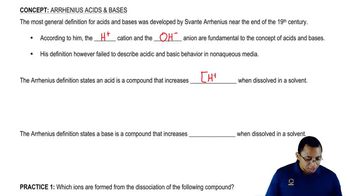
Acids and bases are fundamental concepts in chemistry that describe substances based on their ability to donate or accept protons (H+ ions). Acids are proton donors, while bases are proton acceptors. This classification is essential for understanding chemical reactions, pH levels, and the behavior of various compounds in solution.
Recommended video:
Guided course
03:11
Arrhenius Acids & Bases Concept 1

Strong Acids

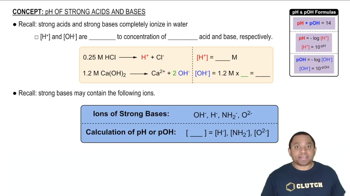
Strong acids are substances that completely dissociate in water, releasing all of their protons into the solution. This results in a high concentration of H+ ions, leading to a low pH. Hydroiodic acid (HI) is classified as a strong acid because it fully ionizes in aqueous solution, making it a key example in acid-base chemistry.
Recommended video:
Guided course
02:39
Strong Acids and Bases

pH Scale

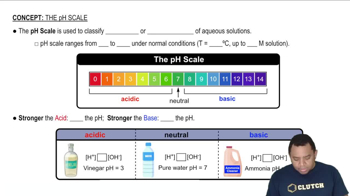
The pH scale is a logarithmic scale used to measure the acidity or basicity of a solution, ranging from 0 to 14. A pH less than 7 indicates an acidic solution, while a pH greater than 7 indicates a basic solution. Understanding the pH scale is crucial for identifying the nature of substances, such as determining that HI is an acid due to its low pH when dissolved in water.
Recommended video: