Pearson+ LogoPearson+ Logo
Ch.10 Acids and Bases and Equilibrium
Timberlake - Chemistry: An Introduction to General, Organic, and Biological Chemistry 13th Edition
Timberlake13th EditionChemistry: An Introduction to General, Organic, and Biological ChemistryISBN: 9780134421353Not the one you use?Change textbook
Chapter 10, Problem 72b

Identify each of the following as an acid or a base:
b. H2SO3

Verified step by step guidance
1
Step 1: Recall the definition of acids and bases. Acids are substances that donate protons (H⁺ ions) in aqueous solutions, while bases are substances that accept protons or produce hydroxide ions (OH⁻) in aqueous solutions.
Step 2: Examine the chemical formula of the given compound, H₂SO₃. This is sulfurous acid, which contains hydrogen atoms that can potentially be donated as H⁺ ions.
Step 3: Recognize that the presence of hydrogen atoms at the beginning of the formula (H₂) is a common indicator of an acid. These hydrogens are ionizable and can dissociate in water to release H⁺ ions.
Step 4: Consider the context of the compound in water. When H₂SO₃ dissolves in water, it dissociates partially to form H⁺ ions and HSO₃⁻ ions, confirming its behavior as an acid.
Step 5: Conclude that H₂SO₃ is an acid because it donates H⁺ ions in aqueous solutions, which aligns with the definition of an acid.

Verified video answer for a similar problem:

This video solution was recommended by our tutors as helpful for the problem above.
Video duration:
1m
Was this helpful?

Key Concepts

Here are the essential concepts you must grasp in order to answer the question correctly.

Acids and Bases

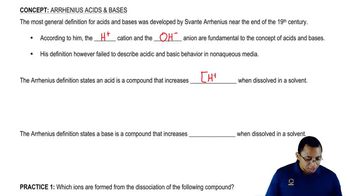
Acids are substances that can donate protons (H⁺ ions) in a solution, while bases are substances that can accept protons. This definition is rooted in the Brønsted-Lowry theory, which emphasizes the transfer of protons in acid-base reactions. Understanding this distinction is crucial for classifying compounds like H₂SO₃.
Recommended video:
Guided course
03:11
Arrhenius Acids & Bases Concept 1

Sulfurous Acid (H₂SO₃)

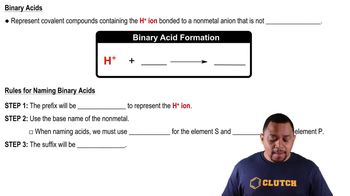
H₂SO₃, or sulfurous acid, is a weak acid formed when sulfur dioxide (SO₂) dissolves in water. It can dissociate in solution to release H⁺ ions, which is characteristic of acids. Recognizing H₂SO₃ as an acid is essential for understanding its behavior in chemical reactions and its role in various environmental processes.
Recommended video:

pH Scale

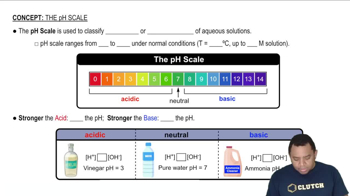
The pH scale measures the acidity or basicity of a solution, ranging from 0 (strongly acidic) to 14 (strongly basic), with 7 being neutral. A solution with a pH less than 7 indicates the presence of more H⁺ ions, typical of acids like H₂SO₃. Familiarity with the pH scale helps in predicting the properties and reactions of acids and bases.
Recommended video: