Pearson+ LogoPearson+ Logo
Ch.10 Acids and Bases and Equilibrium
Timberlake - Chemistry: An Introduction to General, Organic, and Biological Chemistry 13th Edition
Timberlake13th EditionChemistry: An Introduction to General, Organic, and Biological ChemistryISBN: 9780134421353Not the one you use?Change textbook
Chapter 10, Problem 15b

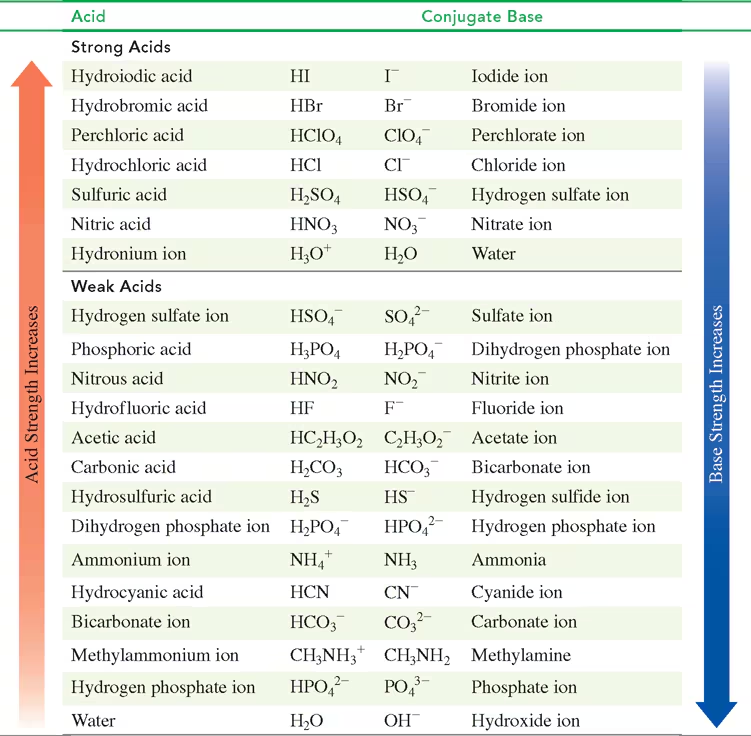
Using TABLE 10.3, identify the stronger acid in each of the following pairs:
Table comparing strong and weak acids with their conjugate bases, highlighting acid strength increases.
b. H3PO4 or HSO4-

Verified step by step guidance
1
Step 1: Refer to Table 10.3 or the provided graph to compare the acid strengths of H₃PO₄ (phosphoric acid) and HSO₄⁻ (hydrogen sulfate ion). The graph shows an arrow indicating increasing acid strength.
Step 2: Locate the position of H₃PO₄ and HSO₄⁻ on the graph. H₃PO₄ is positioned lower on the graph, while HSO₄⁻ is higher, indicating that HSO₄⁻ is the stronger acid.
Step 3: Understand the reasoning behind the comparison. Acid strength is determined by the ability to donate protons (H⁺). HSO₄⁻ is a stronger acid because it dissociates more readily to donate a proton compared to H₃PO₄.
Step 4: Note that H₃PO₄ is a weak acid, while HSO₄⁻ is considered a stronger acid due to its position closer to the top of the graph.
Step 5: Conclude that HSO₄⁻ is the stronger acid in this pair based on the graph and the concept of acid dissociation.

Verified video answer for a similar problem:

This video solution was recommended by our tutors as helpful for the problem above.
Video duration:
38s
Was this helpful?

Key Concepts

Here are the essential concepts you must grasp in order to answer the question correctly.

Acid Strength

Acid strength refers to the ability of an acid to donate protons (H⁺ ions) in a solution. Stronger acids dissociate more completely in water, leading to a higher concentration of H⁺ ions. This property is often quantified using the acid dissociation constant (Ka), where a larger Ka value indicates a stronger acid.
Recommended video:
Guided course
00:50
Acid and Base Strength Concept 3

H₃PO₄ (Phosphoric Acid)

H₃PO₄, or phosphoric acid, is a triprotic acid, meaning it can donate three protons. Its strength is moderate compared to other acids, and it is often used in food and beverages. Understanding its dissociation steps is crucial for comparing its strength to other acids, such as HSO₄⁻.
Recommended video:
Guided course
02:42
Naming Acids Example 2

HSO₄⁻ (Hydrogen Sulfate Ion)

HSO₄⁻, or hydrogen sulfate ion, is the conjugate base of sulfuric acid (H₂SO₄) and is considered a stronger acid than H₃PO₄. It can donate a proton to form SO₄²⁻, and its ability to dissociate makes it a key player in acid-base reactions. Recognizing its strength relative to other acids is essential for determining which is stronger in a given comparison.
Recommended video:
Guided course
1:22
Hydrogenation Reactions Concept 1