Pearson+ LogoPearson+ Logo
Ch.10 Acids and Bases and Equilibrium
Timberlake - Chemistry: An Introduction to General, Organic, and Biological Chemistry 13th Edition
Timberlake13th EditionChemistry: An Introduction to General, Organic, and Biological ChemistryISBN: 9780134421353Not the one you use?Change textbook
Chapter 10, Problem 19

What is meant by the term reversible reaction?

Verified step by step guidance
1
A reversible reaction is a chemical reaction where the reactants can form products, and the products can revert back to reactants under certain conditions.
In a reversible reaction, the forward reaction (reactants forming products) and the reverse reaction (products forming reactants) occur simultaneously.
The reaction reaches a state of dynamic equilibrium when the rate of the forward reaction equals the rate of the reverse reaction, meaning the concentrations of reactants and products remain constant over time.
Reversible reactions are typically represented using a double arrow (⇌) in chemical equations, indicating that both the forward and reverse reactions are possible.
An example of a reversible reaction is the dissociation of acetic acid in water: \( \text{CH}_3\text{COOH} \leftrightarrow \text{CH}_3\text{COO}^- + \text{H}^+ \).

Verified video answer for a similar problem:

This video solution was recommended by our tutors as helpful for the problem above.
Video duration:
3m
Was this helpful?

Key Concepts

Here are the essential concepts you must grasp in order to answer the question correctly.

Reversible Reaction

A reversible reaction is a chemical process where the reactants can be converted into products and, under certain conditions, the products can be converted back into the original reactants. This dynamic equilibrium allows both forward and reverse reactions to occur, depending on factors like concentration, temperature, and pressure.

Chemical Equilibrium

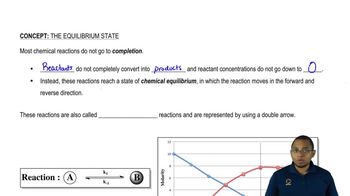
Chemical equilibrium is the state in which the rates of the forward and reverse reactions are equal, resulting in constant concentrations of reactants and products over time. At this point, the system is balanced, and no net change occurs, although both reactions continue to take place.
Recommended video:
Guided course
03:42
Chemical Equilibrium Concept 1

Le Chatelier's Principle

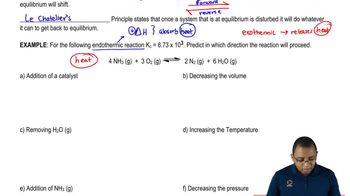
Le Chatelier's Principle states that if a system at equilibrium is subjected to a change in concentration, temperature, or pressure, the system will adjust to counteract that change and restore a new equilibrium. This principle helps predict how a reversible reaction will respond to external changes.