Pearson+ LogoPearson+ Logo
Ch.10 Acids and Bases and Equilibrium
Timberlake - Chemistry: An Introduction to General, Organic, and Biological Chemistry 13th Edition
Timberlake13th EditionChemistry: An Introduction to General, Organic, and Biological ChemistryISBN: 9780134421353Not the one you use?Change textbook
Chapter 10, Problem 33d

Calculate the [H3O+] of each aqueous solution with the following [OH-]:
d. bile, 2.5 × 10⁻⁶ M

Verified step by step guidance
1
Step 1: Recall the relationship between [H₃O⁺] and [OH⁻] in aqueous solutions, which is governed by the ion-product constant for water (Kw). At 25°C, Kw = 1.0 × 10⁻¹⁴. The formula is: Kw=[H3O]×[OH-.
Step 2: Rearrange the formula to solve for [H₃O⁺]: [H3O]=Kw[OH-.
Step 3: Substitute the given value of [OH⁻] (2.5 × 10⁻⁶ M) and Kw (1.0 × 10⁻¹⁴) into the formula: [H3O]=1.0×10-142.5×10⁻⁶.
Step 4: Perform the division to calculate [H₃O⁺]. Ensure you handle the exponents correctly by subtracting the exponents in the numerator and denominator.
Step 5: Express the final result in proper scientific notation, ensuring the significant figures match the precision of the given data (2 significant figures).

Verified video answer for a similar problem:

This video solution was recommended by our tutors as helpful for the problem above.
Video duration:
57s
Was this helpful?

Key Concepts

Here are the essential concepts you must grasp in order to answer the question correctly.

pH and pOH Relationship

The pH and pOH of a solution are related through the equation pH + pOH = 14 at 25°C. This relationship allows us to calculate the concentration of hydronium ions [H₃O⁺] from the concentration of hydroxide ions [OH⁻]. By knowing the [OH⁻], we can find pOH, and subsequently derive pH, which gives us [H₃O⁺] using the formula [H₃O⁺] = 10^(-pH).
Recommended video:
Guided course
00:48
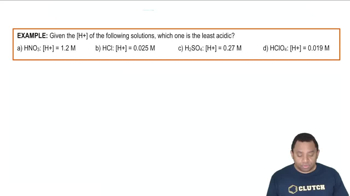
Least Acidic Solution Example

Ion Product of Water (Kw)

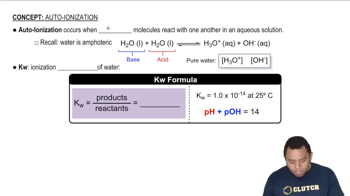
The ion product of water (Kw) is a constant at a given temperature, defined as Kw = [H₃O⁺][OH⁻]. At 25°C, Kw is equal to 1.0 x 10⁻¹⁴. This relationship is crucial for calculating the concentration of hydronium ions when the concentration of hydroxide ions is known, as it allows us to rearrange the equation to find [H₃O⁺] = Kw / [OH⁻].
Recommended video:
Guided course
02:22
Auto-Ionization and Kw

Concentration Units in Chemistry

Concentration in chemistry is often expressed in molarity (M), which is moles of solute per liter of solution. Understanding how to manipulate these units is essential for calculations involving [H₃O⁺] and [OH⁻]. In this context, the given concentration of bile as 2.5 x 10⁻⁶ M [OH⁻] must be used to derive the corresponding [H₃O⁺] concentration through the established relationships.
Recommended video:
Guided course
00:52
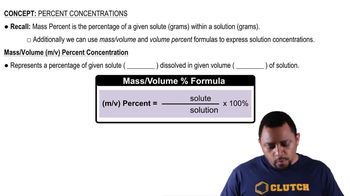
Percent Concentrations Concept 1