Pearson+ LogoPearson+ Logo
Ch.10 Acids and Bases and Equilibrium
Timberlake - Chemistry: An Introduction to General, Organic, and Biological Chemistry 13th Edition
Timberlake13th EditionChemistry: An Introduction to General, Organic, and Biological ChemistryISBN: 9780134421353Not the one you use?Change textbook
Chapter 10, Problem 10a

Write the formula for the conjugate base for each of the following acids:
a. HCO3-

Verified step by step guidance
1
Identify the definition of a conjugate base: A conjugate base is formed when an acid donates a proton (H⁺). This means you remove one H⁺ ion from the acid and adjust the charge accordingly.
Start with the given acid, HCO₃⁻. This is bicarbonate, which has a negative charge of -1.
Remove one H⁺ ion from HCO₃⁻. Removing H⁺ means subtracting one hydrogen atom and reducing the charge by 1 (since H⁺ has a +1 charge).
After removing H⁺, the remaining species is CO₃²⁻. This is carbonate, which now has a charge of -2.
Write the formula for the conjugate base: The conjugate base of HCO₃⁻ is CO₃²⁻.

Verified video answer for a similar problem:

This video solution was recommended by our tutors as helpful for the problem above.
Video duration:
2m
Was this helpful?

Key Concepts

Here are the essential concepts you must grasp in order to answer the question correctly.

Conjugate Base

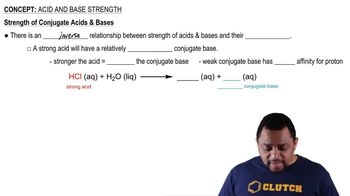
A conjugate base is the species that remains after an acid donates a proton (H⁺). In the context of Brønsted-Lowry acid-base theory, when an acid loses a proton, it transforms into its conjugate base, which can then potentially accept a proton in future reactions.
Recommended video:
Guided course
00:50
Acid and Base Strength Concept 3

Acid-Base Reaction

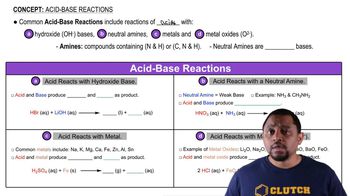
An acid-base reaction involves the transfer of protons between reactants. Acids are proton donors, while bases are proton acceptors. Understanding this dynamic is crucial for identifying conjugate pairs, as each acid has a corresponding conjugate base formed after the proton transfer.
Recommended video:
Guided course
03:08
Acid-Base Reactions Concept 1

Bicarbonate Ion (HCO₃⁻)

The bicarbonate ion (HCO₃⁻) is a weak acid that can donate a proton to form its conjugate base, carbonate (CO₃²⁻). Recognizing the structure and behavior of bicarbonate is essential for determining its conjugate base, as it illustrates the principles of acid-base chemistry in action.
Recommended video:
Guided course
01:16
Polyatomic Ions