Pearson+ LogoPearson+ Logo
Ch.11 Introduction to Organic Chemistry: Hydrocarbons
Timberlake - Chemistry: An Introduction to General, Organic, and Biological Chemistry 13th Edition
Timberlake13th EditionChemistry: An Introduction to General, Organic, and Biological ChemistryISBN: 9780134421353Not the one you use?Change textbook
Chapter 11, Problem 24a

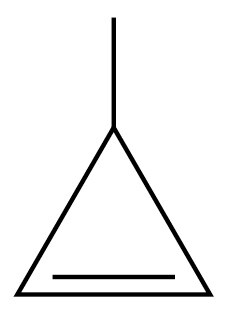
Identify the following as alkanes, alkenes, cycloalkenes, or alkynes:
a. Line drawing of a triangular flask with a narrow neck, commonly used in chemistry for experiments.

Verified step by step guidance
1
Step 1: Understand the definitions of the terms provided in the problem. Alkanes are hydrocarbons with only single bonds between carbon atoms. Alkenes are hydrocarbons with at least one double bond between carbon atoms. Cycloalkenes are cyclic hydrocarbons with at least one double bond in the ring structure. Alkynes are hydrocarbons with at least one triple bond between carbon atoms.
Step 2: Examine the structure of the compound in the image provided. Look for the presence of single, double, or triple bonds between carbon atoms, as well as whether the structure is linear or cyclic.
Step 3: If the compound contains only single bonds, classify it as an alkane. If it contains at least one double bond, classify it as an alkene. If it contains at least one triple bond, classify it as an alkyne. If it is cyclic and contains a double bond, classify it as a cycloalkene.
Step 4: Pay attention to any additional features in the structure, such as functional groups or branching, but focus primarily on the bonding and cyclic nature to determine the classification.
Step 5: Based on the observations from the image, assign the correct classification (alkane, alkene, cycloalkene, or alkyne) to the compound.

Verified video answer for a similar problem:

This video solution was recommended by our tutors as helpful for the problem above.
Was this helpful?

Key Concepts

Here are the essential concepts you must grasp in order to answer the question correctly.

Alkanes

Alkanes are saturated hydrocarbons that contain only single bonds between carbon atoms. They follow the general formula CnH2n+2, where 'n' is the number of carbon atoms. Alkanes are typically less reactive than other types of hydrocarbons and are commonly found in natural gas and petroleum.
Recommended video:
Guided course
1:20
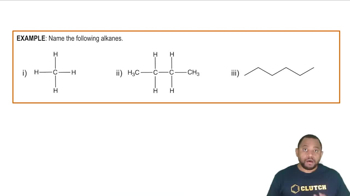
Naming Alkanes Example 1

Alkenes

Alkenes are unsaturated hydrocarbons characterized by at least one carbon-carbon double bond. Their general formula is CnH2n, indicating that they have fewer hydrogen atoms than alkanes. Alkenes are more reactive than alkanes due to the presence of the double bond, making them important in chemical synthesis and industrial applications.
Recommended video:
Guided course
3:26
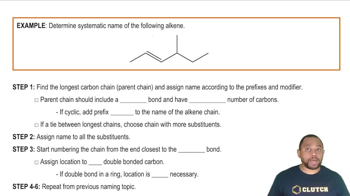
Naming Alkenes Example 1

Cycloalkenes

Cycloalkenes are a subset of alkenes that contain a ring structure and at least one carbon-carbon double bond. They can be represented by the formula CnH2n-2, reflecting the ring's closure and the presence of the double bond. Cycloalkenes exhibit unique properties and reactivity patterns due to their cyclic structure, making them significant in organic chemistry.
Recommended video:
Guided course
0:36
Rules for Naming Cyclic Alkanes Concept 1