Pearson+ LogoPearson+ Logo
Ch.12 Alcohols, Thiols, Ethers, Aldehydes, and Ketones
Timberlake - Chemistry: An Introduction to General, Organic, and Biological Chemistry 13th Edition
Timberlake13th EditionChemistry: An Introduction to General, Organic, and Biological ChemistryISBN: 9780134421353Not the one you use?Change textbook
Chapter 12, Problem 39

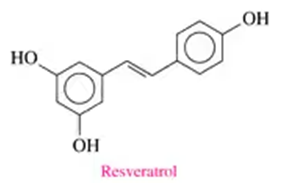
A compound called resveratrol is an antioxidant, found in the skin of grapes. Identify the functional groups in resveratrol.

<IMAGE>

Verified step by step guidance
1
Examine the structure of resveratrol provided in the image. Look for characteristic arrangements of atoms that correspond to functional groups, such as hydroxyl (-OH), carbonyl (C=O), or aromatic rings.
Identify any hydroxyl (-OH) groups in the structure. These are typically represented as an oxygen atom bonded to a hydrogen atom, attached to a carbon atom.
Look for aromatic rings in the structure. Aromatic rings are cyclic structures with alternating double bonds, often represented as a hexagon with a circle inside.
Check for any double or triple bonds between carbon atoms, which could indicate the presence of alkenes (C=C) or alkynes (C≡C).
Summarize the identified functional groups in resveratrol, such as hydroxyl groups, aromatic rings, or any other relevant groups observed in the structure.

Verified video answer for a similar problem:

This video solution was recommended by our tutors as helpful for the problem above.
Was this helpful?

Key Concepts

Here are the essential concepts you must grasp in order to answer the question correctly.

Functional Groups

Functional groups are specific groups of atoms within molecules that are responsible for the characteristic chemical reactions of those molecules. They determine the properties and reactivity of organic compounds. Common functional groups include hydroxyl (-OH), carboxyl (-COOH), and phenyl (-C6H5), each influencing the behavior of the compound in biological systems.
Recommended video:
Guided course
1:11
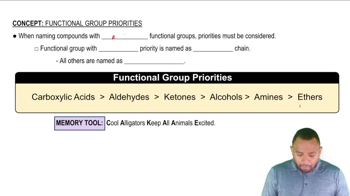
Functional Group Priorities Concept 1

Antioxidants

Antioxidants are molecules that inhibit the oxidation of other molecules, thereby preventing cellular damage caused by free radicals. They play a crucial role in protecting the body from oxidative stress, which is linked to various diseases. Resveratrol, as an antioxidant, helps neutralize free radicals and may contribute to health benefits associated with grape consumption.

Chemical Structure of Resveratrol

The chemical structure of resveratrol includes multiple functional groups, primarily hydroxyl groups (-OH) and a double bond in its carbon skeleton. This structure is essential for its biological activity, including its antioxidant properties. Understanding the arrangement of these functional groups helps in identifying how resveratrol interacts with other molecules in biological systems.
Recommended video:
Guided course
00:58
Chemical Reaction: Chemical Change Concept 1