Pearson+ LogoPearson+ Logo
Ch.12 Alcohols, Thiols, Ethers, Aldehydes, and Ketones
Timberlake - Chemistry: An Introduction to General, Organic, and Biological Chemistry 13th Edition
Timberlake13th EditionChemistry: An Introduction to General, Organic, and Biological ChemistryISBN: 9780134421353Not the one you use?Change textbook
Chapter 12, Problem 42

Which of the following will give a positive Tollens' test?
a. 1-propanol
b. 2-propanol
c. hexanal

Verified step by step guidance
1
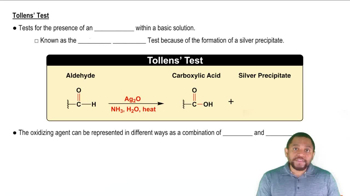
Understand the Tollens' test: The Tollens' test is a chemical test used to identify aldehydes. It involves the use of Tollens' reagent, which contains silver ions (Ag⁺) in an ammonia solution. Aldehydes are oxidized to carboxylic acids, and the silver ions are reduced to metallic silver, forming a characteristic silver mirror on the test tube.
Analyze the given compounds: a. 1-propanol is a primary alcohol, b. 2-propanol is a secondary alcohol, and c. hexanal is an aldehyde. Recall that the Tollens' test specifically reacts with aldehydes, not alcohols.
Determine the functional group of each compound: Alcohols (1-propanol and 2-propanol) do not have the carbonyl group (C=O) characteristic of aldehydes, so they will not react with Tollens' reagent. Hexanal, on the other hand, contains an aldehyde group (R-CHO), which can be oxidized by Tollens' reagent.
Predict the outcome of the test: Since hexanal is an aldehyde, it will give a positive Tollens' test, resulting in the formation of a silver mirror. The other two compounds, 1-propanol and 2-propanol, will not react and will give a negative Tollens' test.
Conclude: The compound that will give a positive Tollens' test is hexanal (option c).

Verified video answer for a similar problem:

This video solution was recommended by our tutors as helpful for the problem above.
Was this helpful?

Key Concepts

Here are the essential concepts you must grasp in order to answer the question correctly.

Tollens' Test

Tollens' test is a qualitative test used to identify aldehydes and certain reducing sugars. It involves the use of Tollens' reagent, which contains silver nitrate in ammonia, that oxidizes aldehydes to carboxylic acids while reducing silver ions to metallic silver. A positive result is indicated by the formation of a silver mirror on the test container.
Recommended video:
Guided course
1:50
Tollens' Test Concept 2

Aldehydes vs. Alcohols

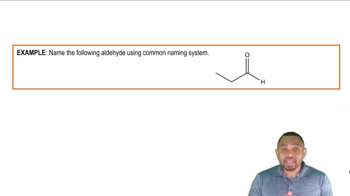
Aldehydes are organic compounds characterized by the presence of a carbonyl group (C=O) at the end of the carbon chain, making them reactive in oxidation reactions. In contrast, alcohols contain a hydroxyl group (–OH) and are generally less reactive towards oxidation, particularly secondary and tertiary alcohols, which do not yield a positive Tollens' test.
Recommended video:
Guided course
0:34
Naming Aldehydes Example 2

Oxidation and Reduction

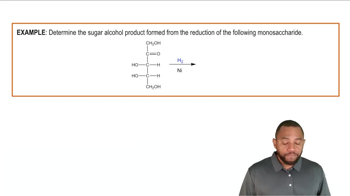
Oxidation refers to the loss of electrons or an increase in oxidation state, while reduction involves the gain of electrons or a decrease in oxidation state. In the context of Tollens' test, aldehydes are oxidized to carboxylic acids, and the silver ions in Tollens' reagent are reduced to metallic silver, demonstrating the redox nature of the reaction.
Recommended video:
Guided course
0:55
Reduction of Monosaccharides Example 1