Pearson+ LogoPearson+ Logo
Ch.15 Lipids
Timberlake - Chemistry: An Introduction to General, Organic, and Biological Chemistry 13th Edition
Timberlake13th EditionChemistry: An Introduction to General, Organic, and Biological ChemistryISBN: 9780134421353Not the one you use?Change textbook
Chapter 15, Problem 28

How does the percentage of monounsaturated and polyunsaturated fatty acids in olive oil compare to that of canola oil?

Verified step by step guidance
1
Understand the composition of fatty acids in olive oil and canola oil. Olive oil is known to have a high percentage of monounsaturated fatty acids (MUFAs), primarily oleic acid, while canola oil contains both monounsaturated and polyunsaturated fatty acids (PUFAs) in significant amounts.
Define the terms monounsaturated and polyunsaturated fatty acids. Monounsaturated fatty acids have one double bond in their hydrocarbon chain, while polyunsaturated fatty acids have two or more double bonds.
Research the approximate fatty acid composition of olive oil and canola oil. Olive oil typically contains about 70-80% monounsaturated fatty acids and a smaller percentage of polyunsaturated fatty acids (around 10%). Canola oil, on the other hand, contains about 60% monounsaturated fatty acids and a higher percentage of polyunsaturated fatty acids (around 30%).
Compare the percentages of monounsaturated fatty acids in both oils. Olive oil has a higher percentage of monounsaturated fatty acids compared to canola oil.
Compare the percentages of polyunsaturated fatty acids in both oils. Canola oil has a higher percentage of polyunsaturated fatty acids compared to olive oil.

Verified video answer for a similar problem:

This video solution was recommended by our tutors as helpful for the problem above.
Video duration:
3m
Was this helpful?

Key Concepts

Here are the essential concepts you must grasp in order to answer the question correctly.

Fatty Acid Composition

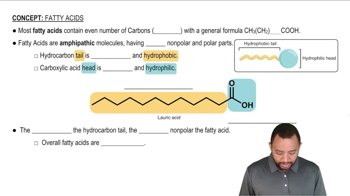
Fatty acids are the building blocks of fats, and they can be classified into saturated, monounsaturated, and polyunsaturated types. Monounsaturated fatty acids (MUFAs) have one double bond in their structure, while polyunsaturated fatty acids (PUFAs) have multiple double bonds. Understanding the composition of these fatty acids in oils is crucial for evaluating their health benefits and nutritional profiles.
Recommended video:
Guided course
2:00
Fatty Acids Concept 1

Nutritional Benefits of Oils

Different types of fatty acids have varying effects on health. Monounsaturated fats are known to improve heart health by reducing bad cholesterol levels, while polyunsaturated fats, including omega-3 and omega-6 fatty acids, are essential for various bodily functions. Comparing the nutritional benefits of olive oil and canola oil requires an understanding of their fatty acid profiles.
Recommended video:
Guided course
04:22
Rutherford Gold Foil Oil Experiment

Culinary Uses and Flavor Profiles

The composition of fatty acids in oils not only affects health but also influences their culinary uses and flavor profiles. Olive oil, rich in monounsaturated fats, has a distinct flavor and is often used in Mediterranean cuisine, while canola oil, with a higher proportion of polyunsaturated fats, has a neutral taste suitable for various cooking methods. Understanding these differences helps in selecting the appropriate oil for specific dishes.
Recommended video:
Guided course
01:04
Gibbs Free Energy (Simplified) Concept 3