What is the difference in the location of the first double bond in an omega-3 and an omega-6 fatty acid (see Chemistry Link to Health “Omega-3 Fatty Acids in Fish Oils”)?
Ch.15 Lipids
Timberlake13th EditionChemistry: An Introduction to General, Organic, and Biological ChemistryISBN: 9780134421353Not the one you use?Change textbook
Chapter 15, Problem 22
Draw the condensed structural formula for a mixed triacylglycerol that contains two palmitic acid molecules and one oleic acid molecule on the center carbon of glycerol.
Verified step by step guidance1
Understand the structure of a triacylglycerol: A triacylglycerol consists of a glycerol backbone (a three-carbon molecule with hydroxyl groups on each carbon) esterified with three fatty acid molecules. In this case, two palmitic acid molecules and one oleic acid molecule are involved.
Identify the structure of palmitic acid and oleic acid: Palmitic acid is a saturated fatty acid with the formula CH₃(CH₂)₁₄COOH, while oleic acid is a monounsaturated fatty acid with the formula CH₃(CH₂)₇CH=CH(CH₂)₇COOH. The double bond in oleic acid is in the cis configuration.
Assign the fatty acids to the glycerol backbone: Place the two palmitic acid molecules on the first and third carbons of the glycerol backbone, and the oleic acid molecule on the center (second) carbon of glycerol.
Write the condensed structural formula: Start with the glycerol backbone, then replace the hydroxyl groups (-OH) with the esterified fatty acid chains. For example, the first carbon will have an ester bond to the palmitic acid chain, the second carbon will have an ester bond to the oleic acid chain, and the third carbon will have an ester bond to the second palmitic acid chain.
Combine the components into the final condensed structural formula: Represent the glycerol backbone and the attached fatty acid chains in a condensed format, ensuring the correct placement of the palmitic and oleic acid molecules. Use parentheses to indicate repeating CH₂ groups and the double bond in oleic acid.

Verified video answer for a similar problem:
This video solution was recommended by our tutors as helpful for the problem above.
Video duration:
3mWas this helpful?
Key Concepts
Here are the essential concepts you must grasp in order to answer the question correctly.
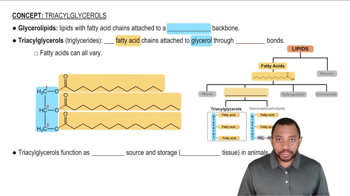
Triacylglycerol Structure
Triacylglycerols, or triglycerides, are esters formed from glycerol and three fatty acids. The glycerol backbone consists of three carbon atoms, each capable of binding to a fatty acid via an ester bond. Understanding the structural arrangement of these components is crucial for drawing the condensed structural formula.
Recommended video:
Guided course
Triacylglycerols Concept 1
Fatty Acids
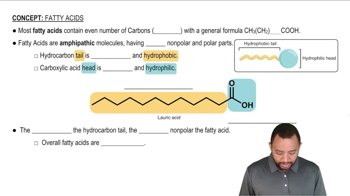
Fatty acids are long hydrocarbon chains with a carboxylic acid group at one end. In this case, palmitic acid (a saturated fatty acid) and oleic acid (a monounsaturated fatty acid) are specified. Recognizing the differences in saturation and structure of these fatty acids is essential for accurately representing them in the triacylglycerol.
Recommended video:
Guided course
Fatty Acids Concept 1
Condensed Structural Formula
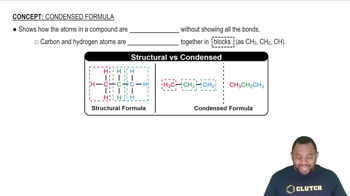
A condensed structural formula provides a simplified representation of a molecule, showing the arrangement of atoms without depicting all bonds explicitly. It is important to understand how to represent the connectivity of the glycerol and fatty acids in this format, particularly when indicating which fatty acids are attached to which carbons.
Recommended video:
Guided course
Condensed Formula Concept 1
Related Practice
Textbook Question
779
views
Textbook Question
Draw the condensed structural formula for the ester in jojoba wax that is formed from arachidic acid, a 20-carbon saturated fatty acid, and 1-docosanol, CH3–(CH2)21–OH.
803
views
Textbook Question
Draw the condensed structural formula for a triacylglycerol that contains stearic acid and glycerol.
774
views
Textbook Question
Safflower oil is polyunsaturated, whereas olive oil is monounsaturated. Why would safflower oil have a lower melting point than olive oil?
618
views
Textbook Question
How does the percentage of monounsaturated and polyunsaturated fatty acids in olive oil compare to that of canola oil?
674
views
Textbook Question
Identify each of the following processes as hydrogenation, hydrolysis, or saponification and give the products:
a. the reaction of palm oil with KOH
808
views