Pearson+ LogoPearson+ Logo
Ch.15 Lipids
Timberlake - Chemistry: An Introduction to General, Organic, and Biological Chemistry 13th Edition
Timberlake13th EditionChemistry: An Introduction to General, Organic, and Biological ChemistryISBN: 9780134421353Not the one you use?Change textbook
Chapter 15, Problem 29a

Identify each of the following processes as hydrogenation, hydrolysis, or saponification and give the products:
a. the reaction of palm oil with KOH

Verified step by step guidance
1
Step 1: Recognize the type of reaction. The problem involves the reaction of palm oil with KOH (potassium hydroxide). Palm oil is a triglyceride, which is a type of fat or oil. When a triglyceride reacts with a strong base like KOH, the reaction is classified as saponification.
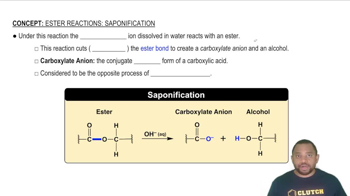
Step 2: Understand the saponification process. Saponification is the base-catalyzed hydrolysis of triglycerides. In this reaction, the ester bonds in the triglyceride are broken, resulting in the formation of glycerol and the salts of fatty acids.
Step 3: Write the general chemical equation for saponification. A triglyceride reacts with three molecules of KOH to produce one molecule of glycerol and three molecules of potassium salts of fatty acids. The general equation can be expressed as: RCOOR' + KOH → RCOOK + R'OH, where R represents the fatty acid chains.
Step 4: Identify the products. The products of the reaction are glycerol (a three-carbon alcohol) and potassium salts of the fatty acids that were originally part of the triglyceride. These potassium salts are commonly referred to as soap.
Step 5: Summarize the reaction. The reaction of palm oil with KOH is a saponification reaction, and the products are glycerol and potassium salts of the fatty acids present in palm oil.

Verified video answer for a similar problem:

This video solution was recommended by our tutors as helpful for the problem above.
Video duration:
2m
Was this helpful?

Key Concepts

Here are the essential concepts you must grasp in order to answer the question correctly.

Hydrogenation

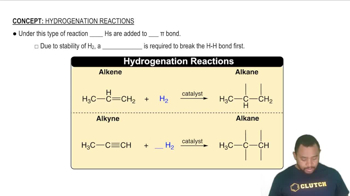
Hydrogenation is a chemical reaction that involves the addition of hydrogen to unsaturated fats or oils, converting them into saturated fats. This process typically occurs in the presence of a catalyst, such as nickel, and is used to solidify liquid oils, improving their stability and shelf life.
Recommended video:
Guided course
1:22
Hydrogenation Reactions Concept 1

Hydrolysis

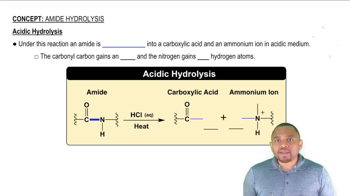
Hydrolysis is a chemical reaction that involves the breaking down of compounds by the addition of water. In the context of fats and oils, hydrolysis can lead to the formation of glycerol and fatty acids, often occurring in the presence of an acid or base, such as KOH, which acts as a catalyst.
Recommended video:
Guided course
1:12
Acidic Hydrolysis Concept 1

Saponification

Saponification is the process of making soap by reacting fats or oils with a strong base, such as sodium hydroxide (NaOH) or potassium hydroxide (KOH). This reaction produces glycerol and fatty acid salts, which are the main components of soap. In the case of palm oil reacting with KOH, saponification would yield potassium salts of fatty acids.
Recommended video:
Guided course
1:25
Ester Reactions: Saponification Concept 1