Pearson+ LogoPearson+ Logo
Ch.16 Amino Acids, Proteins, and Enzymes
Timberlake - Chemistry: An Introduction to General, Organic, and Biological Chemistry 13th Edition
Timberlake13th EditionChemistry: An Introduction to General, Organic, and Biological ChemistryISBN: 9780134421353Not the one you use?Change textbook
Chapter 16, Problem 2c

Classify each of the following proteins according to its function:
c. casein, milk protein

Verified step by step guidance
1
Understand the role of proteins in biological systems. Proteins are macromolecules that perform a wide range of functions, including structural support, catalysis, transport, signaling, and storage.
Recognize that casein is a protein found in milk. It is one of the primary proteins responsible for providing nutrition to mammals during early development.
Classify casein based on its function. Casein is primarily a storage protein, as it stores essential amino acids and nutrients for the growth and development of young mammals.
Consider the broader context of storage proteins. Storage proteins are typically found in seeds, eggs, and milk, where they serve as reservoirs of nutrients.
Conclude that casein, as a milk protein, is classified as a storage protein due to its role in providing essential nutrients for growth and development.

Verified video answer for a similar problem:

This video solution was recommended by our tutors as helpful for the problem above.
Video duration:
1m
Was this helpful?

Key Concepts

Here are the essential concepts you must grasp in order to answer the question correctly.

Protein Classification

Proteins can be classified based on their functions, which include structural support, transport, enzymes, and storage. Understanding the role of a protein helps in categorizing it correctly. For instance, some proteins serve as enzymes that catalyze biochemical reactions, while others may provide structural integrity to cells.
Recommended video:
Guided course
04:19
Classification of Matter

Casein Function

Casein is a family of related proteins found in mammalian milk, making up about 80% of the proteins in cow's milk. Its primary function is to provide a source of amino acids for young mammals, as well as to form a gel or curd in the stomach, which aids in nutrient absorption. Additionally, casein plays a role in calcium and phosphate transport.
Recommended video:
Guided course
02:16
Logarithmic Functions

Nutritional Importance of Milk Proteins

Milk proteins, including casein, are vital for nutrition due to their high biological value, meaning they contain all essential amino acids required for human health. They contribute to muscle repair, growth, and overall bodily functions. Understanding the nutritional role of milk proteins is essential for dietary planning and food science.
Recommended video:
Guided course
2:01
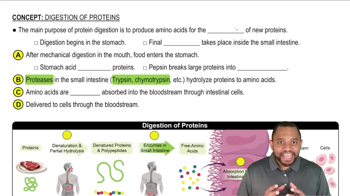
Digestion of Proteins Concept 1