Pearson+ LogoPearson+ Logo
Ch.16 Amino Acids, Proteins, and Enzymes
Timberlake - Chemistry: An Introduction to General, Organic, and Biological Chemistry 13th Edition
Timberlake13th EditionChemistry: An Introduction to General, Organic, and Biological ChemistryISBN: 9780134421353Not the one you use?Change textbook
Chapter 16, Problem 4

How does the polarity of the R group in leucine compare to the R group in serine?

Verified step by step guidance
1
Step 1: Understand the structure of leucine and serine. Both are amino acids, and their R groups (side chains) determine their chemical properties. Leucine has an isobutyl group (-CH2-CH-(CH3)2) as its R group, while serine has a hydroxymethyl group (-CH2-OH) as its R group.
Step 2: Recall the concept of polarity. Polarity arises from the difference in electronegativity between atoms in a bond. Polar molecules have regions of partial positive and negative charges due to uneven electron distribution.
Step 3: Analyze the R group of leucine. The isobutyl group is composed of carbon and hydrogen atoms, which have similar electronegativities. This makes the R group of leucine nonpolar, as there is no significant charge separation.
Step 4: Analyze the R group of serine. The hydroxymethyl group contains an -OH group, where oxygen is significantly more electronegative than hydrogen. This creates a polar bond, making the R group of serine polar.
Step 5: Compare the polarity. The R group of leucine is nonpolar due to its hydrocarbon structure, while the R group of serine is polar because of the presence of the hydroxyl (-OH) group. This difference in polarity affects their solubility and interactions in biological systems.

Verified video answer for a similar problem:

This video solution was recommended by our tutors as helpful for the problem above.
Video duration:
1m
Was this helpful?

Key Concepts

Here are the essential concepts you must grasp in order to answer the question correctly.

Polarity of Amino Acid Side Chains

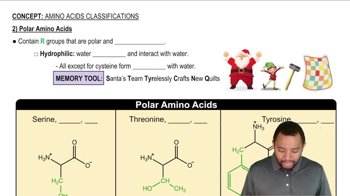
The polarity of amino acid side chains, or R groups, determines their interactions with water and other molecules. Polar side chains, like those in serine, can form hydrogen bonds and are often hydrophilic, while nonpolar side chains, like leucine's, are hydrophobic and tend to avoid water. Understanding this polarity is crucial for predicting the behavior of proteins in biological systems.
Recommended video:
Guided course
2:55
Polar Amino Acids Concept 2

Leucine Structure and Properties

Leucine is a branched-chain amino acid with a nonpolar, hydrophobic R group. This structure contributes to its role in protein folding and stability, as it tends to cluster away from aqueous environments. Recognizing leucine's properties helps in understanding its function in protein structures and interactions.
Recommended video:
Guided course
02:54
Physical Properties Concept

Serine Structure and Properties

Serine is an amino acid with a polar R group that contains a hydroxyl (-OH) group, making it hydrophilic. This polarity allows serine to participate in hydrogen bonding and enzymatic reactions, often acting as a site for phosphorylation. Understanding serine's properties is essential for grasping its role in biochemical processes and protein functionality.
Recommended video:
Guided course
02:54
Physical Properties Concept