Pearson+ LogoPearson+ Logo
Ch.16 Amino Acids, Proteins, and Enzymes
Timberlake - Chemistry: An Introduction to General, Organic, and Biological Chemistry 13th Edition
Timberlake13th EditionChemistry: An Introduction to General, Organic, and Biological ChemistryISBN: 9780134421353Not the one you use?Change textbook
Chapter 16, Problem 6a

Draw the structure for each of the following amino acids at physiological pH:
a. lysine

Verified step by step guidance
1
Understand that at physiological pH (approximately 7.4), amino acids exist in their zwitterionic form. This means the amino group (-NH2) is protonated to form -NH3⁺, and the carboxylic acid group (-COOH) is deprotonated to form -COO⁻.
Identify the structure of lysine. Lysine is an amino acid with a side chain containing a primary amine group (-NH2) attached to a four-carbon chain. Its general structure includes an alpha carbon bonded to an amino group, a carboxyl group, a hydrogen atom, and the side chain.
Modify the structure of lysine to reflect its zwitterionic form at physiological pH. The alpha amino group (-NH2) becomes -NH3⁺, and the alpha carboxyl group (-COOH) becomes -COO⁻.
Add the side chain of lysine to the structure. The side chain contains a terminal amino group (-NH2) that remains protonated as -NH3⁺ at physiological pH because it is a basic group.
Combine all components to draw the complete structure of lysine at physiological pH. Ensure the alpha carbon is central, with the amino group (-NH3⁺), carboxylate group (-COO⁻), hydrogen atom, and the side chain (with its terminal -NH3⁺ group) correctly attached.

Verified video answer for a similar problem:

This video solution was recommended by our tutors as helpful for the problem above.
Video duration:
1m
Was this helpful?

Key Concepts

Here are the essential concepts you must grasp in order to answer the question correctly.

Amino Acid Structure

Amino acids are organic compounds that serve as the building blocks of proteins. Each amino acid consists of a central carbon atom (the alpha carbon) bonded to an amino group (-NH2), a carboxyl group (-COOH), a hydrogen atom, and a variable side chain (R group) that determines the specific properties of the amino acid.
Recommended video:
Guided course
3:03
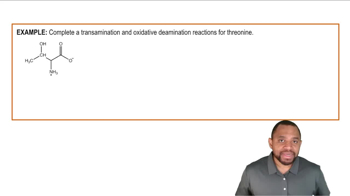
Amino Acid Catabolism: Amino Group Example 2

Physiological pH

Physiological pH refers to the pH level of human blood and other bodily fluids, which is typically around 7.4. At this pH, amino acids can exist in their zwitterionic form, where the amino group is protonated (-NH3+) and the carboxyl group is deprotonated (-COO-), affecting their overall charge and solubility.
Recommended video:
Guided course
02:09
pH and pOH Calculations

Lysine Properties

Lysine is a basic amino acid characterized by its positively charged side chain at physiological pH. Its side chain contains an additional amino group, which contributes to its basicity and makes lysine essential for protein synthesis, enzyme function, and various metabolic processes in the body.
Recommended video:
Guided course
02:11
Chemical Properties Example 1