Pearson+ LogoPearson+ Logo
Ch.16 Amino Acids, Proteins, and Enzymes
Timberlake - Chemistry: An Introduction to General, Organic, and Biological Chemistry 13th Edition
Timberlake13th EditionChemistry: An Introduction to General, Organic, and Biological ChemistryISBN: 9780134421353Not the one you use?Change textbook
Chapter 16, Problem 24a

In myoglobin, about one-half of the 153 amino acids have nonpolar R groups.
a. Where would you expect those amino acids to be located in the tertiary structure?

Verified step by step guidance
1
Understand the nature of nonpolar R groups: Nonpolar R groups are hydrophobic, meaning they tend to avoid water and prefer to interact with other nonpolar molecules or regions.
Recall the structure of myoglobin: Myoglobin is a globular protein with a tertiary structure, meaning it folds into a compact, three-dimensional shape. This folding is influenced by the interactions of amino acid side chains with their environment.
Consider the environment of the protein: In an aqueous (water-based) environment, hydrophobic (nonpolar) amino acids tend to cluster together in the interior of the protein to avoid contact with water. This is known as the hydrophobic effect.
Predict the location of nonpolar amino acids: Based on the hydrophobic effect, the nonpolar amino acids in myoglobin are most likely located in the interior of the protein, where they are shielded from the surrounding water.
Relate this to protein stability: The clustering of nonpolar amino acids in the interior contributes to the stability of the protein's tertiary structure by minimizing unfavorable interactions with water and maximizing favorable interactions among nonpolar groups.

Verified video answer for a similar problem:

This video solution was recommended by our tutors as helpful for the problem above.
Video duration:
3m
Was this helpful?

Key Concepts

Here are the essential concepts you must grasp in order to answer the question correctly.

Tertiary Structure of Proteins

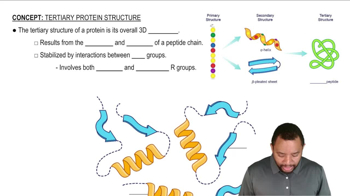
The tertiary structure of a protein refers to its three-dimensional shape formed by the folding and interactions of its amino acid chains. This structure is stabilized by various interactions, including hydrogen bonds, ionic bonds, and hydrophobic interactions. Understanding the tertiary structure is crucial for predicting how proteins function and interact with other molecules.
Recommended video:
Guided course
2:07
Tertiary Protein Structure Concept 1

Hydrophobic and Hydrophilic Interactions

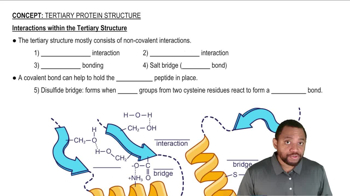
Hydrophobic interactions occur when nonpolar R groups of amino acids cluster together to avoid contact with water, while hydrophilic interactions involve polar R groups that are attracted to water. In the context of protein structure, nonpolar amino acids are typically found in the interior of the protein, away from the aqueous environment, which helps maintain the protein's stability and functionality.
Recommended video:
Guided course
2:41
Interactions within the Tertiary Structure Concept 2

Amino Acid Properties

Amino acids are the building blocks of proteins, and their properties are determined by their R groups (side chains). Nonpolar R groups are hydrophobic and tend to be located in the interior of proteins, while polar or charged R groups are hydrophilic and often found on the surface. Recognizing these properties is essential for understanding how amino acids contribute to the overall structure and behavior of proteins.
Recommended video:
Guided course
3:03
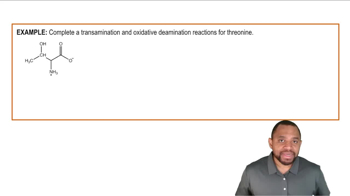
Amino Acid Catabolism: Amino Group Example 2