Pearson+ LogoPearson+ Logo
Ch.16 Amino Acids, Proteins, and Enzymes
Timberlake - Chemistry: An Introduction to General, Organic, and Biological Chemistry 13th Edition
Timberlake13th EditionChemistry: An Introduction to General, Organic, and Biological ChemistryISBN: 9780134421353Not the one you use?Change textbook
Chapter 16, Problem 23c

A portion of a polypeptide chain contains the following sequence of amino acids:
—Leu—Val—Cys—Asp—
c. How does the primary structure of a protein affect its tertiary structure?

Verified step by step guidance
1
The primary structure of a protein refers to the specific sequence of amino acids in the polypeptide chain. This sequence is determined by the genetic code and is unique to each protein.
The sequence of amino acids in the primary structure determines the chemical properties of the side chains (R groups), such as whether they are hydrophobic, hydrophilic, acidic, or basic.
These chemical properties influence how the polypeptide chain folds into its three-dimensional shape (tertiary structure). For example, hydrophobic side chains tend to cluster together in the interior of the protein, while hydrophilic side chains are often exposed to the aqueous environment.
Interactions between side chains, such as hydrogen bonding, ionic interactions, disulfide bonds (e.g., between cysteine residues), and van der Waals forces, further stabilize the tertiary structure.
In summary, the primary structure acts as a blueprint that dictates the folding and final three-dimensional shape of the protein, which is critical for its biological function.

Verified video answer for a similar problem:

This video solution was recommended by our tutors as helpful for the problem above.
Video duration:
5m
Was this helpful?

Key Concepts

Here are the essential concepts you must grasp in order to answer the question correctly.

Primary Structure of Proteins

The primary structure of a protein refers to the specific sequence of amino acids in a polypeptide chain. This sequence is determined by the genetic code and dictates how the protein will fold and function. Each amino acid has unique properties that influence the overall structure and stability of the protein.
Recommended video:
Guided course
1:11
Primary Protein Structure Example 1

Tertiary Structure of Proteins

The tertiary structure of a protein is the three-dimensional shape formed by the folding and interactions of the polypeptide chain. This structure is stabilized by various interactions, including hydrogen bonds, ionic bonds, hydrophobic interactions, and disulfide bridges. The tertiary structure is crucial for the protein's functionality, as it determines the active sites and overall shape.
Recommended video:
Guided course
2:07
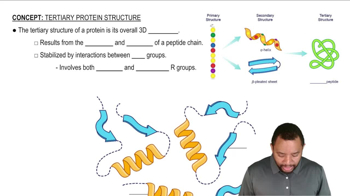
Tertiary Protein Structure Concept 1

Structure-Function Relationship

The structure-function relationship in proteins highlights how the specific arrangement of amino acids (primary structure) influences the protein's final shape (tertiary structure) and, consequently, its biological function. Changes in the primary structure can lead to alterations in the tertiary structure, potentially affecting the protein's ability to perform its intended role in biological processes.
Recommended video:
Guided course
04:56
Logarithmic Relationships