Pearson+ LogoPearson+ Logo
Ch.17 Nucleic Acids and Protein Synthesis
Timberlake - Chemistry: An Introduction to General, Organic, and Biological Chemistry 13th Edition
Timberlake13th EditionChemistry: An Introduction to General, Organic, and Biological ChemistryISBN: 9780134421353Not the one you use?Change textbook
Chapter 17, Problem 97

Draw the condensed structural formula for CMP.

Verified step by step guidance
1
Understand the problem: CMP refers to cytidine monophosphate, a nucleotide composed of the nucleoside cytidine (cytosine base attached to a ribose sugar) and a single phosphate group. The goal is to represent its structure in a condensed form.
Identify the components of CMP: (1) the cytosine base, (2) the ribose sugar, and (3) the phosphate group. These components are connected in a specific way: the cytosine is attached to the ribose at the 1' carbon, and the phosphate group is attached to the 5' carbon of the ribose.
Write the condensed structural formula for the cytosine base: Cytosine is a pyrimidine base with the formula C₄H₅N₃O. In condensed form, it is represented as a ring structure with appropriate double bonds and functional groups.
Write the condensed structural formula for the ribose sugar: Ribose is a five-carbon sugar with the formula C₅H₁₀O₅. In condensed form, it is written as a chain or ring, with the 1' carbon connected to the cytosine and the 5' carbon connected to the phosphate group.
Combine the components: Link the cytosine, ribose, and phosphate group in the correct order to form the condensed structural formula for CMP. Ensure that the phosphate group is represented as PO₄³⁻ and is attached to the 5' carbon of the ribose.

Verified video answer for a similar problem:

This video solution was recommended by our tutors as helpful for the problem above.
Video duration:
1m
Was this helpful?

Key Concepts

Here are the essential concepts you must grasp in order to answer the question correctly.

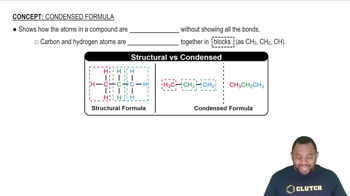
Condensed Structural Formula

A condensed structural formula is a way of representing a chemical compound that shows the arrangement of atoms and the connectivity between them without depicting all the bonds explicitly. It simplifies the structure by grouping atoms together, often indicating functional groups and the overall molecular framework. This format is particularly useful for organic compounds, allowing chemists to quickly understand the composition and structure.
Recommended video:
Guided course
1:53
Condensed Formula Concept 1

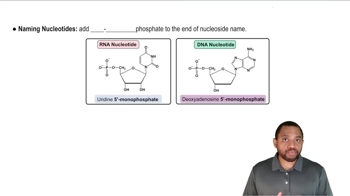
CMP (Cytidine Monophosphate)

Cytidine monophosphate (CMP) is a nucleotide that consists of a cytosine base, a ribose sugar, and a single phosphate group. It plays a crucial role in cellular metabolism and is a building block for RNA synthesis. Understanding its structure is essential for grasping its function in biological processes, including energy transfer and signal transduction.
Recommended video:
Guided course
1:21
Naming Nucleosides and Nucleotides Concept 2

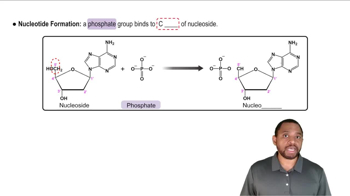
Nucleotide Structure

Nucleotides are the basic building blocks of nucleic acids, composed of three components: a nitrogenous base, a five-carbon sugar, and one or more phosphate groups. The arrangement and type of these components determine the specific nucleotide and its properties. In the case of CMP, the presence of the cytosine base and the ribose sugar, along with a single phosphate, is critical for its role in RNA and cellular functions.
Recommended video:
Guided course
1:19
Nucleoside and Nucleotide Formation Concept 2