Pearson+ LogoPearson+ Logo
Ch.17 Nucleic Acids and Protein Synthesis
Timberlake - Chemistry: An Introduction to General, Organic, and Biological Chemistry 13th Edition
Timberlake13th EditionChemistry: An Introduction to General, Organic, and Biological ChemistryISBN: 9780134421353Not the one you use?Change textbook
Chapter 17, Problem 106c

Write the complementary base sequence for each of the following DNA segments:
c. G G C C T A C C T T A A C G A C G

Verified step by step guidance
1
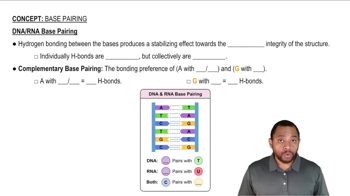
Understand that DNA is composed of two complementary strands, where specific base pairing rules apply: Adenine (A) pairs with Thymine (T), and Cytosine (C) pairs with Guanine (G).
Identify the given DNA sequence: G G C C T A C C T T A A C G A C G.
For each base in the given sequence, determine its complementary base using the pairing rules: G pairs with C, C pairs with G, T pairs with A, and A pairs with T.
Write the complementary sequence by replacing each base in the original sequence with its complementary base. For example, the first base G will pair with C, the second base G will pair with C, and so on.
Continue this process for the entire sequence to construct the complementary strand, ensuring that the sequence is written in the same 5' to 3' direction as the original strand.

Verified video answer for a similar problem:

This video solution was recommended by our tutors as helpful for the problem above.
Video duration:
2m
Was this helpful?

Key Concepts

Here are the essential concepts you must grasp in order to answer the question correctly.

DNA Structure

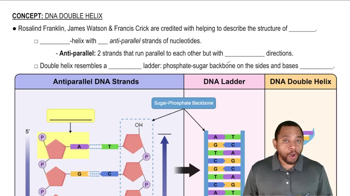
DNA is composed of two strands that form a double helix, with each strand made up of nucleotides. Each nucleotide consists of a sugar, a phosphate group, and a nitrogenous base. The four nitrogenous bases in DNA are adenine (A), thymine (T), cytosine (C), and guanine (G). The specific pairing of these bases (A with T and C with G) is crucial for the stability and replication of DNA.
Recommended video:
Guided course
3:27
DNA Double Helix Concept 1

Complementary Base Pairing

Complementary base pairing refers to the specific pairing of nitrogenous bases in DNA. Adenine pairs with thymine, and cytosine pairs with guanine. This pairing is essential for the accurate replication of DNA and the transmission of genetic information. When determining the complementary sequence, each base in a DNA strand is matched with its corresponding partner.
Recommended video:
Guided course
2:56
Base Pairing Concept 1

Transcription and Translation

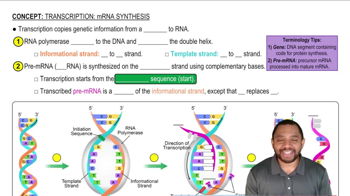
Transcription is the process by which the DNA sequence is copied into messenger RNA (mRNA), which then serves as a template for translation into proteins. Understanding the flow of genetic information from DNA to RNA to protein is fundamental in molecular biology. While the question focuses on DNA sequences, knowledge of transcription is important for comprehending how these sequences ultimately influence protein synthesis.
Recommended video:
Guided course
6:37
Transcription: mRNA Synthesis Concept 1