Pearson+ LogoPearson+ Logo
Ch.18 Metabolic Pathways and ATP Production
Timberlake - Chemistry: An Introduction to General, Organic, and Biological Chemistry 13th Edition
Timberlake13th EditionChemistry: An Introduction to General, Organic, and Biological ChemistryISBN: 9780134421353Not the one you use?Change textbook
Chapter 18, Problem 74a

Arachidic acid is a C20 fatty acid found in peanut and fish oils.
a. How many cycles of β oxidation are needed for the complete oxidation of arachidic acid?

Verified step by step guidance
1
Determine the number of carbon atoms in arachidic acid. The problem states that arachidic acid is a C₂₀ fatty acid, meaning it contains 20 carbon atoms.
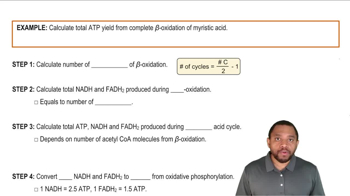
Recall that each cycle of β-oxidation removes a two-carbon acetyl-CoA unit from the fatty acid chain. This means the number of cycles required is determined by dividing the total number of carbon atoms by 2 and then subtracting 1 (since the final two-carbon unit does not require an additional cycle).
Set up the calculation: \( \text{Number of cycles} = \frac{\text{Total carbon atoms}}{2} - 1 \). For arachidic acid, substitute 20 for the total carbon atoms: \( \text{Number of cycles} = \frac{20}{2} - 1 \).
Simplify the expression: First, divide 20 by 2 to determine the number of two-carbon units, then subtract 1 to account for the final acetyl-CoA unit that does not require a separate cycle.
The result of this calculation will give you the total number of β-oxidation cycles required for the complete oxidation of arachidic acid.

Verified video answer for a similar problem:

This video solution was recommended by our tutors as helpful for the problem above.
Video duration:
1m
Was this helpful?

Key Concepts

Here are the essential concepts you must grasp in order to answer the question correctly.

Beta Oxidation

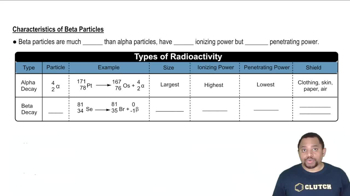
Beta oxidation is a metabolic process that breaks down fatty acids into acetyl-CoA units, which can then enter the citric acid cycle for energy production. Each cycle of beta oxidation shortens the fatty acid chain by two carbon atoms, releasing energy in the form of ATP. Understanding this process is crucial for determining how many cycles are needed to fully oxidize a fatty acid like arachidic acid.
Recommended video:
Guided course
01:26
Beta Decay Example 1

Fatty Acid Structure

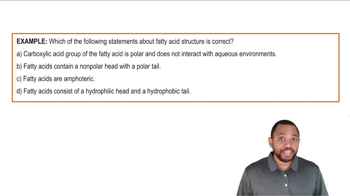
Fatty acids are carboxylic acids with long hydrocarbon chains, and their structure determines how they are metabolized. Arachidic acid, specifically, is a saturated fatty acid with 20 carbon atoms. Recognizing the number of carbon atoms in a fatty acid is essential for calculating the number of beta oxidation cycles required for its complete oxidation.
Recommended video:
Guided course
0:55
Fatty Acids Example 1

Energy Yield from Fatty Acids

The complete oxidation of fatty acids yields significant amounts of energy, primarily in the form of ATP. Each cycle of beta oxidation produces one FADH2 and one NADH, which are then used in the electron transport chain to generate ATP. Knowing the energy yield from each cycle helps in understanding the overall energy production from the oxidation of arachidic acid.
Recommended video:
Guided course
4:19
Total Energy from Fatty Acids Example 1