Pearson+ LogoPearson+ Logo
Ch.18 Metabolic Pathways and ATP Production
Timberlake - Chemistry: An Introduction to General, Organic, and Biological Chemistry 13th Edition
Timberlake13th EditionChemistry: An Introduction to General, Organic, and Biological ChemistryISBN: 9780134421353Not the one you use?Change textbook
Chapter 18, Problem 53

How are glycolysis and the citric acid cycle linked to the production of ATP by electron transport?

Verified step by step guidance
1
Understand that glycolysis and the citric acid cycle are metabolic pathways that break down glucose and other molecules to produce energy intermediates. Glycolysis occurs in the cytoplasm, while the citric acid cycle occurs in the mitochondria.
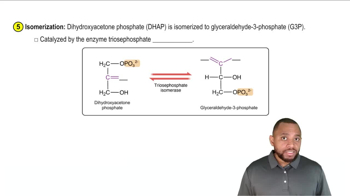
Recognize that during glycolysis, glucose is converted into pyruvate, producing ATP and NADH. NADH is an electron carrier that plays a crucial role in the electron transport chain.
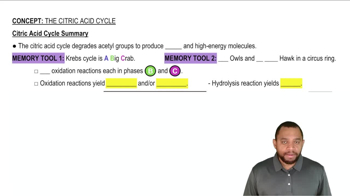
Learn that in the citric acid cycle, pyruvate is further oxidized to produce carbon dioxide, ATP (or GTP), NADH, and FADH₂. Both NADH and FADH₂ are electron carriers that store high-energy electrons.
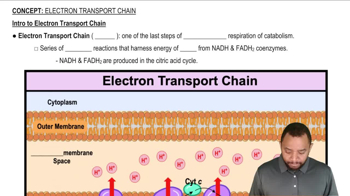
Understand that NADH and FADH₂ donate their high-energy electrons to the electron transport chain located in the inner mitochondrial membrane. This chain consists of a series of protein complexes that transfer electrons and pump protons across the membrane.
Recognize that the proton gradient created by the electron transport chain drives ATP synthesis through a process called oxidative phosphorylation. ATP synthase uses the energy from the flow of protons back into the mitochondrial matrix to convert ADP and inorganic phosphate (Pi) into ATP.

Verified video answer for a similar problem:

This video solution was recommended by our tutors as helpful for the problem above.
Video duration:
2m
Was this helpful?

Key Concepts

Here are the essential concepts you must grasp in order to answer the question correctly.

Glycolysis

Glycolysis is the metabolic pathway that converts glucose into pyruvate, producing a small amount of ATP and NADH in the process. This occurs in the cytoplasm and is the first step in cellular respiration, providing the necessary substrates for the citric acid cycle. The ATP generated here is crucial for cellular energy, while NADH serves as an electron carrier for subsequent processes.
Recommended video:
Guided course
1:26
Glycolysis Concept 5

Citric Acid Cycle

The citric acid cycle, also known as the Krebs cycle, takes place in the mitochondria and processes acetyl-CoA derived from pyruvate. It generates additional NADH and FADH2, which are vital for the electron transport chain. This cycle not only contributes to ATP production but also plays a key role in the metabolism of carbohydrates, fats, and proteins.
Recommended video:
Guided course
2:31
Citric Acid Cycle Summary Concept 12

Electron Transport Chain

The electron transport chain (ETC) is a series of protein complexes located in the inner mitochondrial membrane that transfer electrons from NADH and FADH2 to oxygen, the final electron acceptor. This process creates a proton gradient that drives ATP synthesis through oxidative phosphorylation. The ETC is essential for maximizing ATP yield from the substrates generated in glycolysis and the citric acid cycle.
Recommended video:
Guided course
3:10
Intro to Electron Transport Chain Concept 1