Pearson+ LogoPearson+ Logo
Ch.18 Metabolic Pathways and ATP Production
Timberlake - Chemistry: An Introduction to General, Organic, and Biological Chemistry 13th Edition
Timberlake13th EditionChemistry: An Introduction to General, Organic, and Biological ChemistryISBN: 9780134421353Not the one you use?Change textbook
Chapter 18, Problem 44

What happens to the energy level as electrons are passed along in electron transport?

Verified step by step guidance
1
Understand the concept of electron transport: Electron transport occurs in the mitochondria during cellular respiration, specifically in the electron transport chain (ETC). Electrons are transferred through a series of protein complexes embedded in the inner mitochondrial membrane.
Recognize the role of energy levels: As electrons move through the electron transport chain, they are passed from one protein complex to another. Each transfer involves a change in energy level, as electrons move from higher-energy states to lower-energy states.
Explain the energy release: The decrease in energy level as electrons are passed along the chain is used to pump protons (H⁺ ions) across the mitochondrial membrane, creating a proton gradient. This gradient is essential for ATP synthesis.
Connect to ATP production: The energy stored in the proton gradient is harnessed by ATP synthase to convert ADP and inorganic phosphate (Pi) into ATP, the primary energy currency of the cell.
Summarize the process: The electron transport chain is a mechanism for converting the energy from high-energy electrons into a usable form (ATP) by systematically lowering their energy level and utilizing the released energy for cellular work.

Verified video answer for a similar problem:

This video solution was recommended by our tutors as helpful for the problem above.
Video duration:
34s
Was this helpful?

Key Concepts

Here are the essential concepts you must grasp in order to answer the question correctly.

Electron Transport Chain

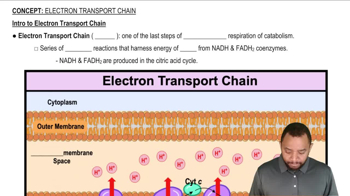
The electron transport chain (ETC) is a series of protein complexes and other molecules located in the inner mitochondrial membrane. It facilitates the transfer of electrons from electron donors like NADH and FADH2 to electron acceptors, ultimately leading to the production of ATP. As electrons move through the chain, they release energy, which is used to pump protons across the membrane, creating a proton gradient.
Recommended video:
Guided course
3:10
Intro to Electron Transport Chain Concept 1

Energy Levels and Redox Reactions

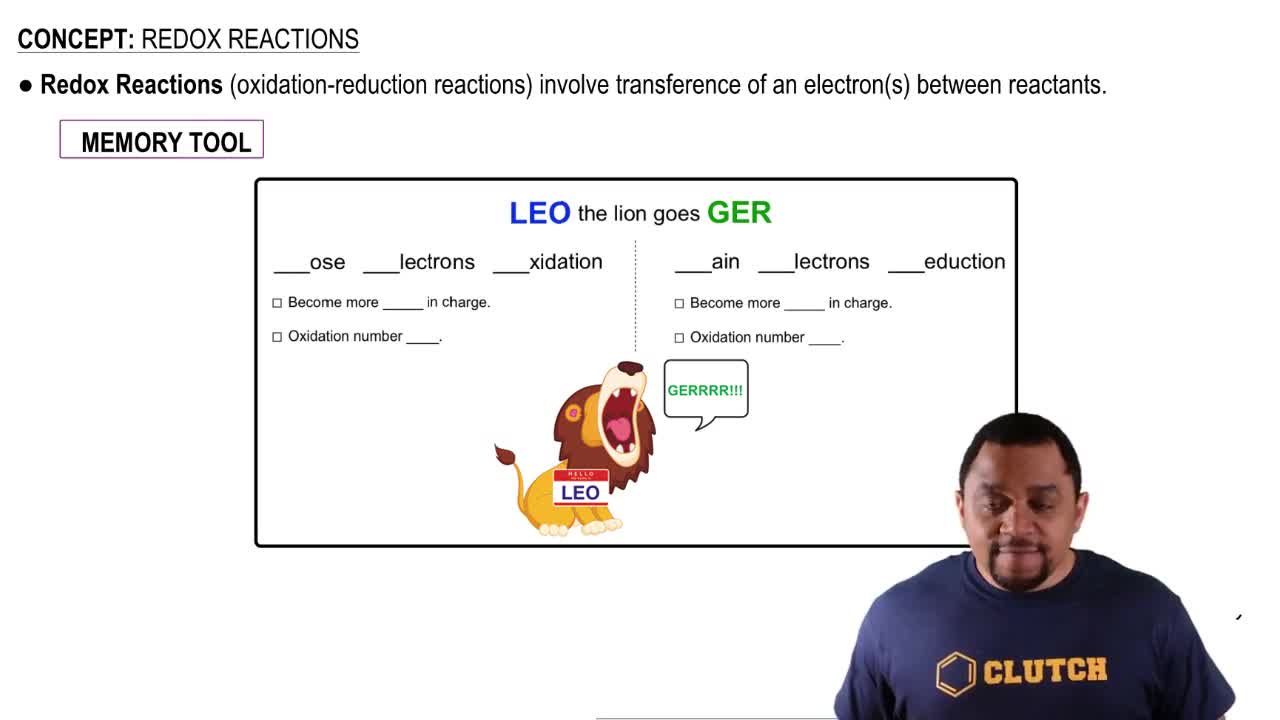
In the context of the electron transport chain, energy levels refer to the potential energy associated with electrons as they undergo redox reactions. As electrons are transferred from higher to lower energy states, energy is released. This energy is harnessed to perform work, such as synthesizing ATP, and is a fundamental principle of cellular respiration.
Recommended video:
Guided course
01:53
Redox Reactions

Proton Gradient and Chemiosmosis

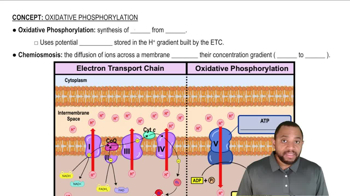
The proton gradient created by the electron transport chain is essential for chemiosmosis, a process that generates ATP. As protons are pumped into the intermembrane space, a concentration gradient forms, driving protons back into the mitochondrial matrix through ATP synthase. This flow of protons provides the energy needed to convert ADP and inorganic phosphate into ATP, linking electron transport to energy production.
Recommended video:
Guided course
2:37
Oxidative Phosphorylation Concept 1