Pearson+ LogoPearson+ Logo
Ch.18 Metabolic Pathways and ATP Production
Timberlake - Chemistry: An Introduction to General, Organic, and Biological Chemistry 13th Edition
Timberlake13th EditionChemistry: An Introduction to General, Organic, and Biological ChemistryISBN: 9780134421353Not the one you use?Change textbook
Chapter 18, Problem 41b

Refer to the diagram of the citric acid cycle in Figure 18.13 to answer each of the following:
b. How is the number of carbon atoms decreased?

Verified step by step guidance
1
Identify the citric acid cycle as a metabolic pathway where acetyl-CoA is oxidized to produce energy, carbon dioxide, and reducing equivalents (NADH and FADH2).
Examine the diagram of the citric acid cycle in Figure 18.13 to locate the steps where carbon atoms are removed from the cycle.
Understand that the removal of carbon atoms occurs through decarboxylation reactions, which are chemical reactions where a carboxyl group (-COOH) is removed as carbon dioxide (CO2).
Note that these decarboxylation reactions are catalyzed by specific enzymes, such as isocitrate dehydrogenase and α-ketoglutarate dehydrogenase, which facilitate the release of CO2 during the cycle.
Count the number of decarboxylation steps in the cycle and observe how the number of carbon atoms decreases as CO2 is released in these reactions.

Verified video answer for a similar problem:

This video solution was recommended by our tutors as helpful for the problem above.
Video duration:
1m
Was this helpful?

Key Concepts

Here are the essential concepts you must grasp in order to answer the question correctly.

Citric Acid Cycle

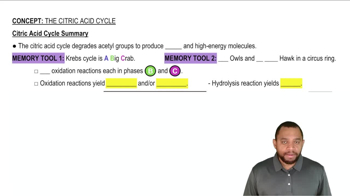
The citric acid cycle, also known as the Krebs cycle, is a series of chemical reactions used by all aerobic organisms to generate energy. It occurs in the mitochondria and involves the oxidation of acetyl-CoA to produce ATP, NADH, and FADH2. The cycle is crucial for cellular respiration and plays a key role in the metabolic pathway that converts carbohydrates, fats, and proteins into energy.
Recommended video:
Guided course
2:31
Citric Acid Cycle Summary Concept 12

Decarboxylation

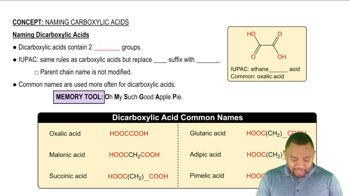
Decarboxylation is a chemical reaction that removes a carboxyl group from a molecule, releasing carbon dioxide (CO2) as a byproduct. In the context of the citric acid cycle, decarboxylation occurs during specific steps, such as the conversion of isocitrate to alpha-ketoglutarate and alpha-ketoglutarate to succinyl-CoA, effectively reducing the number of carbon atoms in the cycle.
Recommended video:
Guided course
2:21
Naming Dicarboxylic Acids Concept 3

Acetyl-CoA

Acetyl-CoA is a central metabolite in the citric acid cycle, formed from the breakdown of carbohydrates, fats, and proteins. It consists of an acetyl group attached to coenzyme A and serves as the entry point for the cycle. Each molecule of acetyl-CoA contributes two carbon atoms to the cycle, which are subsequently lost as CO2 through decarboxylation, leading to a net decrease in carbon atoms.
Recommended video:
Guided course
1:33
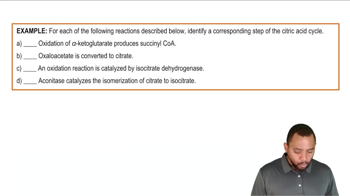
Phase B - Succinyl CoA Formation Example 2