Pearson+ LogoPearson+ Logo
Ch.2 Chemistry and Measurements
Timberlake - Chemistry: An Introduction to General, Organic, and Biological Chemistry 13th Edition
Timberlake13th EditionChemistry: An Introduction to General, Organic, and Biological ChemistryISBN: 9780134421353Not the one you use?Change textbook
Chapter 2, Problem 120

A 50.0-g silver object and a 50.0-g gold object are both added to 75.5 mL of water contained in a graduated cylinder. What is the new water level, in milliliters, in the cylinder?

Verified step by step guidance
1
Identify the densities of silver and gold from the provided table (TABLE 2.8). For example, the density of silver (Ag) is approximately 10.5 g/mL, and the density of gold (Au) is approximately 19.3 g/mL.
Use the formula for density: d=mV, where d is density, m is mass, and V is volume. Rearrange the formula to solve for volume: V=md.
Calculate the volume of the silver object by substituting its mass (50.0 g) and density (10.5 g/mL) into the formula: V=50.010.5.
Calculate the volume of the gold object by substituting its mass (50.0 g) and density (19.3 g/mL) into the formula: V=50.019.3.
Add the initial water volume (75.5 mL) to the volumes of the silver and gold objects to determine the new water level in the graduated cylinder: V=75.5+Vsilver+Vgold.

Verified video answer for a similar problem:

This video solution was recommended by our tutors as helpful for the problem above.
Video duration:
4m
Was this helpful?

Key Concepts

Here are the essential concepts you must grasp in order to answer the question correctly.

Density

Density is defined as mass per unit volume and is a critical property of materials. It determines how much space an object occupies relative to its mass. In this scenario, the densities of silver and gold will influence how much water is displaced when these objects are submerged, which is essential for calculating the new water level.
Recommended video:

Displacement of Water

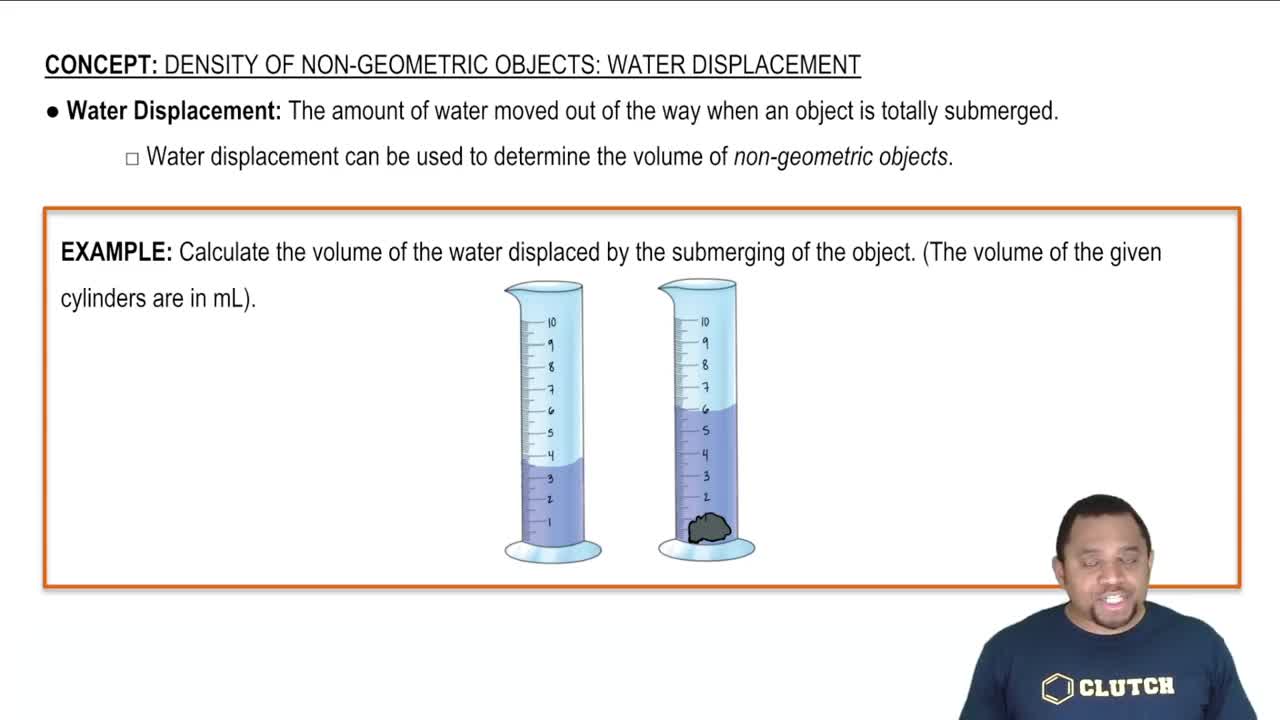
The principle of water displacement states that when an object is submerged in a fluid, it pushes aside a volume of fluid equal to the volume of the object. This principle is crucial for determining the new water level in the graduated cylinder after adding the silver and gold objects, as the total volume of the objects will directly affect the water level.
Recommended video:
Guided course
01:36
Density of Non-Geometric Objects Concept and Example

Volume Calculation

Volume calculation involves determining the space occupied by an object, which can be derived from its mass and density. For the silver and gold objects, knowing their masses allows us to calculate their respective volumes using the formula: Volume = Mass/Density. This calculated volume will be added to the initial water volume to find the new water level.
Recommended video:
Guided course
03:13
Calculate Oxidation Numbers