In France, grapes are 1.95 euros per kilogram. What is the cost of grapes, in dollars per pound, if the exchange rate is 1.14 dollars/euro?
Ch.2 Chemistry and Measurements
Timberlake13th EditionChemistry: An Introduction to General, Organic, and Biological ChemistryISBN: 9780134421353Not the one you use?Change textbook
Chapter 2, Problem 106
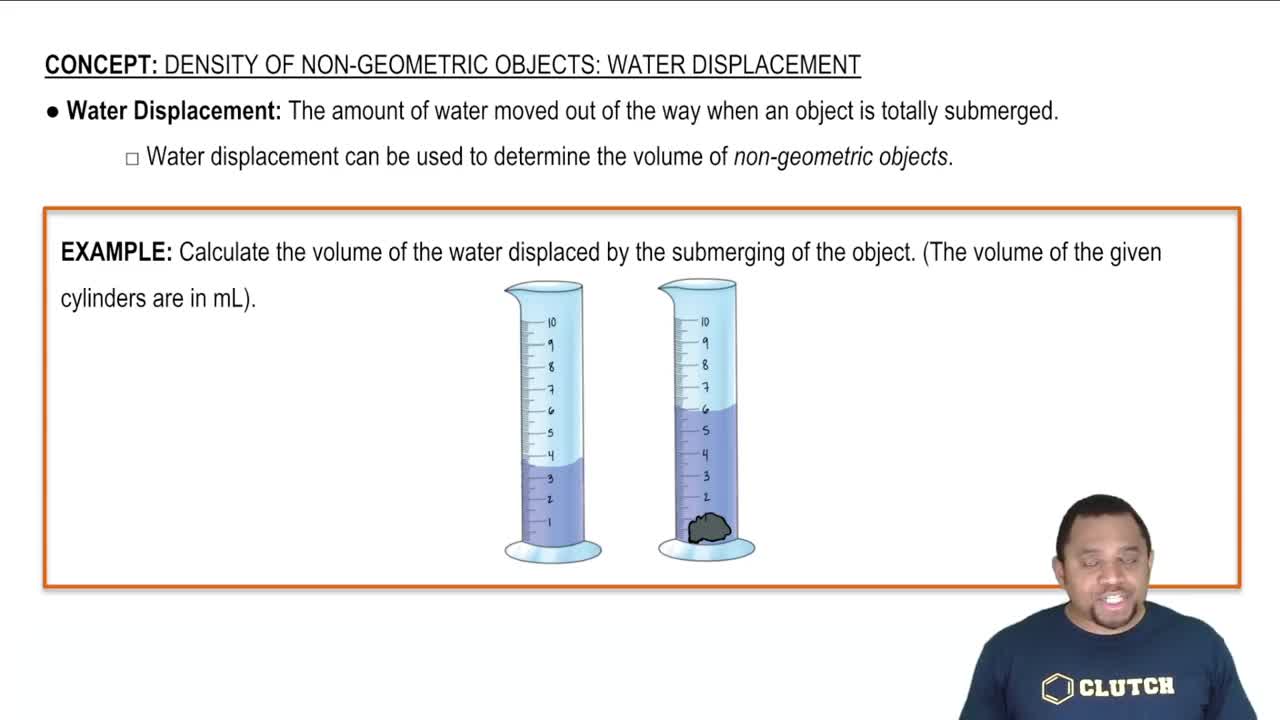
A graduated cylinder contains 155 mL of water. A 15.0-g piece of iron and a 20.0-g piece of lead are added. What is the new water level, in milliliters, in the cylinder?
Verified step by step guidance1
Determine the volume of the iron piece using its mass and density. Use the formula: , where is the mass of the iron (15.0 g) and is the density of iron (from Table 2.8).
Determine the volume of the lead piece using the same formula: , where is the mass of the lead (20.0 g) and is the density of lead (from Table 2.8).
Add the volumes of the iron and lead pieces together to find the total volume displaced by the two metals.
Add the total displaced volume to the initial water volume in the graduated cylinder (155 mL) to calculate the new water level.
Express the final water level in milliliters, ensuring the correct number of significant figures based on the given data.

Verified video answer for a similar problem:
This video solution was recommended by our tutors as helpful for the problem above.
Video duration:
5mWas this helpful?
Key Concepts
Here are the essential concepts you must grasp in order to answer the question correctly.
Displacement of Water
When an object is submerged in a fluid, it displaces a volume of fluid equal to the volume of the object. This principle, known as Archimedes' principle, is crucial for determining the new water level in the graduated cylinder after adding the iron and lead pieces.
Recommended video:
Guided course
Density of Non-Geometric Objects Concept and Example
Density and Mass
Density is defined as mass per unit volume (density = mass/volume). Understanding the densities of iron and lead allows us to calculate their respective volumes when added to the water, which directly affects the water level in the graduated cylinder.
Recommended video:
Guided course
Density
Volume Calculation
To find the new water level, we need to calculate the volume of the added materials using their mass and density. The total volume displaced by both the iron and lead will be added to the initial water volume to determine the final water level in the cylinder.
Recommended video:
Guided course
Calculate Oxidation Numbers
Related Practice
Textbook Question
1607
views
Textbook Question
In Mexico, avocados are 48 pesos per kilogram. What is the cost, in cents, of an avocado that weighs 0.45 lb if the exchange rate is 18 pesos to the dollar?
1535
views
Textbook Question
The water level in a graduated cylinder initially at 215 mL rises to 285 mL after a piece of lead is submerged. What is the mass, in grams, of the lead?
1707
views
Textbook Question
How many milliliters of gasoline have a mass of 1.2 kg?
1619
views
Textbook Question
To treat a bacterial infection, a doctor orders 4 tablets of amoxicillin per day for 10 days. If each tablet contains 250 mg of amoxicillin, how many ounces of the medication are given in 10 days?
1723
views
Textbook Question
A 50.0-g silver object and a 50.0-g gold object are both added to 75.5 mL of water contained in a graduated cylinder. What is the new water level, in milliliters, in the cylinder?
1532
views