Pearson+ LogoPearson+ Logo
Ch.4 Atoms and Elements
Timberlake - Chemistry: An Introduction to General, Organic, and Biological Chemistry 13th Edition
Timberlake13th EditionChemistry: An Introduction to General, Organic, and Biological ChemistryISBN: 9780134421353Not the one you use?Change textbook
Chapter 4, Problem 29a

How many protons and electrons are there in a neutral atom of each of the following elements?
a. argon

Verified step by step guidance
1
Step 1: Understand the concept of a neutral atom. A neutral atom has an equal number of protons and electrons, ensuring that the positive and negative charges balance each other.
Step 2: Locate the element argon on the periodic table. The periodic table provides essential information about each element, including its atomic number.
Step 3: Identify the atomic number of argon. The atomic number represents the number of protons in the nucleus of an atom. For argon, the atomic number is 18.
Step 4: Recognize that in a neutral atom, the number of electrons equals the number of protons. Since argon has 18 protons, it also has 18 electrons in its neutral state.
Step 5: Conclude that a neutral atom of argon contains 18 protons and 18 electrons. This balance ensures the atom has no net electrical charge.

Verified video answer for a similar problem:

This video solution was recommended by our tutors as helpful for the problem above.
Video duration:
1m
Was this helpful?

Key Concepts

Here are the essential concepts you must grasp in order to answer the question correctly.

Atomic Structure

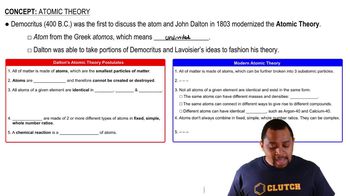
An atom consists of three primary subatomic particles: protons, neutrons, and electrons. Protons are positively charged and reside in the nucleus, while electrons are negatively charged and orbit the nucleus. The number of protons defines the element, and in a neutral atom, the number of electrons equals the number of protons, balancing the overall charge.
Recommended video:
Guided course
05:22
Atomic Theory

Element Identification

Each element is defined by its atomic number, which is the number of protons in its nucleus. For example, argon has an atomic number of 18, meaning it has 18 protons. This atomic number also indicates that a neutral atom of argon will have 18 electrons, maintaining electrical neutrality.
Recommended video:
Guided course
01:14
Valence Electrons of Elements (Simplified) Example 1

Neutral Atoms

A neutral atom has an equal number of protons and electrons, resulting in no overall charge. This balance is crucial for the stability of the atom. In the case of argon, being a noble gas, it is chemically stable and does not readily gain or lose electrons, further emphasizing its neutral state.
Recommended video:
Guided course
05:22
Atomic Theory