Pearson+ LogoPearson+ Logo
Ch.4 Atoms and Elements
Timberlake - Chemistry: An Introduction to General, Organic, and Biological Chemistry 13th Edition
Timberlake13th EditionChemistry: An Introduction to General, Organic, and Biological ChemistryISBN: 9780134421353Not the one you use?Change textbook
Chapter 4, Problem 109

Why is the ionization energy of Ca higher than K, but lower than that of Mg?

Verified step by step guidance
1
Ionization energy is the energy required to remove an electron from a neutral atom in its gaseous state. It depends on factors such as nuclear charge, electron shielding, and the distance of the outermost electron from the nucleus.
Calcium (Ca) has a higher ionization energy than potassium (K) because Ca has a greater nuclear charge (20 protons in Ca vs. 19 protons in K). This stronger nuclear attraction in Ca pulls its outermost electrons closer to the nucleus, making them harder to remove.
Potassium's outermost electron is in the 4s orbital, while calcium's outermost electrons are also in the 4s orbital. However, the additional proton in Ca increases the effective nuclear charge, reducing the shielding effect and increasing the ionization energy compared to K.
Magnesium (Mg) has a higher ionization energy than calcium (Ca) because Mg's outermost electrons are in the 3s orbital, which is closer to the nucleus than the 4s orbital of Ca. The closer proximity to the nucleus results in a stronger attraction, making Mg's electrons harder to remove.
In summary, the ionization energy trend is influenced by the orbital distance and nuclear charge. Ca has a higher ionization energy than K due to a stronger nuclear charge, but a lower ionization energy than Mg because its outermost electrons are farther from the nucleus.

Verified video answer for a similar problem:

This video solution was recommended by our tutors as helpful for the problem above.
Video duration:
4m
Was this helpful?

Key Concepts

Here are the essential concepts you must grasp in order to answer the question correctly.

Ionization Energy

Ionization energy is the energy required to remove an electron from an atom in its gaseous state. It reflects how strongly an atom holds onto its electrons; higher ionization energy indicates a stronger attraction between the nucleus and the electrons. This property varies across the periodic table, influenced by atomic size and effective nuclear charge.
Recommended video:
Guided course
02:13
Periodic Trend: Ionization Energy (Simplified) Concept 1

Periodic Trends

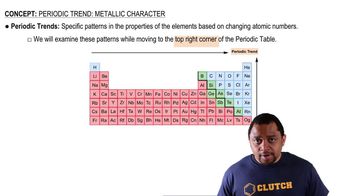
Periodic trends refer to the predictable patterns observed in the properties of elements as you move across or down the periodic table. For ionization energy, it generally increases across a period due to increasing nuclear charge and decreases down a group due to increased atomic size and electron shielding. Understanding these trends helps explain variations in ionization energy among different elements.
Recommended video:
Guided course
00:38
Periodic Trend: Metallic Character

Effective Nuclear Charge

Effective nuclear charge (Z_eff) is the net positive charge experienced by an electron in a multi-electron atom. It accounts for the shielding effect of inner electrons, which reduces the full nuclear charge felt by outer electrons. A higher Z_eff leads to greater attraction between the nucleus and outer electrons, resulting in higher ionization energy, as seen in the comparison of Ca, K, and Mg.
Recommended video:
Guided course
04:38
Solubility: Temperature Effect Concept 1