Pearson+ LogoPearson+ Logo
Ch.5 Nuclear Chemistry
Timberlake - Chemistry: An Introduction to General, Organic, and Biological Chemistry 13th Edition
Timberlake13th EditionChemistry: An Introduction to General, Organic, and Biological ChemistryISBN: 9780134421353Not the one you use?Change textbook
Chapter 5, Problem 60b

Identify each of the following as alpha decay, beta decay, positron emission, or gamma emission:
b. 9038Sr → 9039Y + 0–1e

Verified step by step guidance
1
Step 1: Begin by analyzing the given nuclear equation: ⁹⁰₃₈Sr → ⁹⁰₃₉Y + ⁰₋₁e. Notice that the mass number (superscript) remains the same (90) on both sides of the equation, indicating no change in the total number of nucleons.
Step 2: Observe the atomic numbers (subscripts). The atomic number of strontium (Sr) is 38, and it increases to 39 for yttrium (Y). This indicates that a neutron in the nucleus has been converted into a proton, increasing the atomic number by 1.
Step 3: The emitted particle is represented as ⁰₋₁e, which corresponds to a beta particle (an electron). This is characteristic of beta decay, where a neutron is converted into a proton and an electron is emitted.
Step 4: Recall the definition of beta decay: it is a type of radioactive decay in which a beta particle (electron) is emitted from the nucleus, resulting in an increase in the atomic number by 1 while the mass number remains unchanged.
Step 5: Conclude that the given nuclear reaction represents beta decay, as it matches the criteria of a neutron converting into a proton with the emission of a beta particle (⁰₋₁e).

Verified video answer for a similar problem:

This video solution was recommended by our tutors as helpful for the problem above.
Video duration:
1m
Was this helpful?

Key Concepts

Here are the essential concepts you must grasp in order to answer the question correctly.

Beta Decay

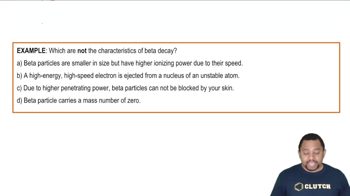
Beta decay is a type of radioactive decay in which a beta particle (an electron or positron) is emitted from an atomic nucleus. In this process, a neutron is transformed into a proton, resulting in an increase in the atomic number of the element. This transformation is crucial for understanding how elements change during radioactive decay, as seen in the provided equation.
Recommended video:
Guided course
06:46
Beta Decay Example 2

Nuclear Reactions

Nuclear reactions involve changes in an atomic nucleus and can result in the transformation of one element into another. These reactions are characterized by the conservation of mass and energy, and they can include various types of decay processes. Understanding nuclear reactions is essential for identifying the type of decay occurring in the given equation.
Recommended video:
Guided course
1:30
Alcohol Reactions: Dehydration Reactions Concept 1

Notation in Nuclear Chemistry

In nuclear chemistry, isotopes and particles are represented using specific notation, where the superscript indicates the mass number and the subscript indicates the atomic number. This notation helps in identifying the elements involved in nuclear reactions and their transformations. Familiarity with this notation is necessary to accurately interpret the decay process in the question.
Recommended video:
Guided course
01:41
Scientific Notation