Pearson+ LogoPearson+ Logo
Ch.5 Nuclear Chemistry
Timberlake - Chemistry: An Introduction to General, Organic, and Biological Chemistry 13th Edition
Timberlake13th EditionChemistry: An Introduction to General, Organic, and Biological ChemistryISBN: 9780134421353Not the one you use?Change textbook
Chapter 5, Problem 60c

Identify each of the following as alpha decay, beta decay, positron emission, or gamma emission:
c. 21885At → 21483Bi + 42He

Verified step by step guidance
1
Step 1: Analyze the given nuclear reaction: ²¹⁸₈₅At → ²¹⁴₈₃Bi + ⁴₂He. Note that the parent nucleus (²¹⁸₈₅At) is transforming into a daughter nucleus (²¹⁴₈₃Bi) and emitting a particle (⁴₂He).
Step 2: Recognize the emitted particle, ⁴₂He, as a helium nucleus. This is characteristic of alpha decay, where the parent nucleus loses 2 protons and 2 neutrons.
Step 3: Verify the conservation of mass number and atomic number. The mass number decreases by 4 (218 → 214), and the atomic number decreases by 2 (85 → 83), consistent with alpha decay.
Step 4: Recall that alpha decay typically occurs in heavy nuclei to reduce their size and stabilize them by emitting an alpha particle (⁴₂He).
Step 5: Conclude that the given nuclear reaction represents alpha decay based on the emission of an alpha particle and the changes in mass and atomic numbers.

Verified video answer for a similar problem:

This video solution was recommended by our tutors as helpful for the problem above.
Video duration:
1m
Was this helpful?

Key Concepts

Here are the essential concepts you must grasp in order to answer the question correctly.

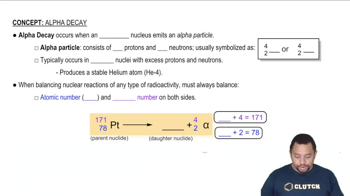
Alpha Decay

Alpha decay is a type of radioactive decay in which an unstable nucleus emits an alpha particle, consisting of two protons and two neutrons. This process reduces the atomic number by two and the mass number by four, resulting in the formation of a new element. It is commonly observed in heavy elements, such as uranium and radium, and is characterized by low penetration power, being stopped by a sheet of paper.
Recommended video:
Guided course
04:23
Alpha Decay Concept 1

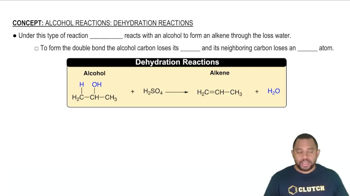
Nuclear Reactions

Nuclear reactions involve changes in an atom's nucleus and can result in the transformation of one element into another. These reactions can include various types of decay, such as alpha and beta decay, as well as nuclear fission and fusion. Understanding the conservation of mass and charge during these reactions is crucial for predicting the products formed, as seen in the example provided.
Recommended video:
Guided course
1:30
Alcohol Reactions: Dehydration Reactions Concept 1

Decay Products

Decay products are the new elements or isotopes formed as a result of radioactive decay. In the case of alpha decay, the original atom loses an alpha particle and transforms into a different element, which is evident in the example where ²¹⁸₈₅At decays into ²¹⁴₈₃Bi and an alpha particle (⁴₂He). Identifying these products is essential for understanding the decay process and its implications in nuclear chemistry.
Recommended video:
Guided course
06:46
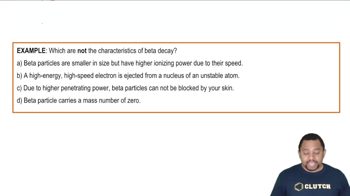
Beta Decay Example 2