Pearson+ LogoPearson+ Logo
Ch.5 Nuclear Chemistry
Timberlake - Chemistry: An Introduction to General, Organic, and Biological Chemistry 13th Edition
Timberlake13th EditionChemistry: An Introduction to General, Organic, and Biological ChemistryISBN: 9780134421353Not the one you use?Change textbook
Chapter 5, Problem 59a

Identify each of the following as alpha decay, beta decay, positron emission, or gamma emission:
a. 27m13Al → 2713Al + 00γ

Verified step by step guidance
1
Step 1: Understand the problem. The question asks us to identify the type of nuclear decay occurring in the given reaction. The reaction shows that an aluminum-27 nucleus (²⁷₁₃Al) remains unchanged and emits a gamma particle (⁰₀γ).
Step 2: Recall the characteristics of gamma emission. Gamma emission involves the release of high-energy photons (⁰₀γ) from the nucleus. It does not change the atomic number or mass number of the nucleus, as it only releases energy.
Step 3: Compare the given reaction to the characteristics of gamma emission. In the reaction, the aluminum-27 nucleus remains the same (atomic number = 13, mass number = 27), and a gamma particle (⁰₀γ) is emitted. This matches the description of gamma emission.
Step 4: Eliminate other types of decay. Alpha decay involves the emission of a helium nucleus (⁴₂He), beta decay involves the emission of an electron (⁰₋₁e), and positron emission involves the emission of a positron (⁰₁e). None of these occur in the given reaction.
Step 5: Conclude that the type of decay in the given reaction is gamma emission, as it matches the characteristics of this process.

Verified video answer for a similar problem:

This video solution was recommended by our tutors as helpful for the problem above.
Video duration:
1m
Was this helpful?

Key Concepts

Here are the essential concepts you must grasp in order to answer the question correctly.

Alpha Decay

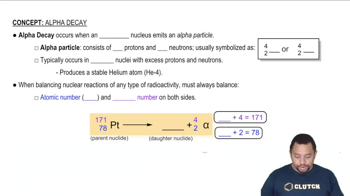
Alpha decay is a type of radioactive decay in which an atomic nucleus emits an alpha particle, consisting of two protons and two neutrons. This process reduces the atomic number of the original element by two and the mass number by four, resulting in a new element. It typically occurs in heavy elements, such as uranium and radium, and is characterized by low penetration power.
Recommended video:
Guided course
04:23
Alpha Decay Concept 1

Beta Decay

Beta decay involves the transformation of a neutron into a proton, or vice versa, within an atomic nucleus, resulting in the emission of a beta particle (an electron or a positron). This process changes the atomic number of the element, leading to the formation of a new element. Beta decay is common in isotopes that are neutron-rich or proton-rich, and it has a moderate penetration power.
Recommended video:
Guided course
06:46
Beta Decay Example 2

Gamma Emission

Gamma emission is the release of gamma rays, which are high-energy electromagnetic radiation, from an excited nucleus as it transitions to a lower energy state. Unlike alpha and beta decay, gamma emission does not change the number of protons or neutrons in the nucleus, meaning the element remains the same. Gamma rays have high penetration power and can pass through most materials, making them significant in nuclear reactions and medical applications.
Recommended video:
Guided course
02:53
Gamma Emission Concept 2