Pearson+ LogoPearson+ Logo
Ch.7 Chemical Quantities and Reactions
Timberlake - Chemistry: An Introduction to General, Organic, and Biological Chemistry 13th Edition
Timberlake13th EditionChemistry: An Introduction to General, Organic, and Biological ChemistryISBN: 9780134421353Not the one you use?Change textbook
Chapter 7, Problem 68a

What is measured by the heat of reaction?

Verified step by step guidance
1
The heat of reaction, also known as enthalpy change (ΔH), measures the amount of heat energy absorbed or released during a chemical reaction at constant pressure.
If ΔH is negative, the reaction is exothermic, meaning it releases heat to the surroundings. Conversely, if ΔH is positive, the reaction is endothermic, meaning it absorbs heat from the surroundings.
The heat of reaction is typically expressed in units of energy, such as joules (J) or kilojoules (kJ), and is often reported per mole of a reactant or product.
To determine the heat of reaction experimentally, calorimetry is commonly used. This involves measuring the temperature change of a system and applying the formula: q = mcΔT, where q is the heat, m is the mass, c is the specific heat capacity, and ΔT is the temperature change.
In chemical equations, the heat of reaction is often written as part of the equation, such as: CH4 + 2O2CO2 + 2H2O + ΔH, where ΔH indicates the heat released or absorbed.

Verified video answer for a similar problem:

This video solution was recommended by our tutors as helpful for the problem above.
Video duration:
2m
Was this helpful?

Key Concepts

Here are the essential concepts you must grasp in order to answer the question correctly.

Heat of Reaction

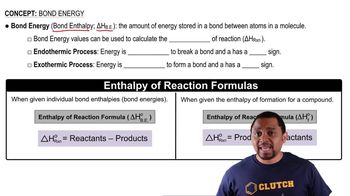
The heat of reaction, also known as enthalpy change, measures the amount of heat absorbed or released during a chemical reaction at constant pressure. It indicates whether a reaction is exothermic (releases heat) or endothermic (absorbs heat), providing insight into the energy dynamics of the reaction.
Recommended video:
Guided course
00:44
Heat Capacity

Enthalpy

Enthalpy is a thermodynamic property that represents the total heat content of a system. It is defined as the sum of the internal energy and the product of pressure and volume. Changes in enthalpy during a reaction help determine the heat of reaction and are crucial for understanding energy transfer in chemical processes.
Recommended video:

Thermochemical Equations

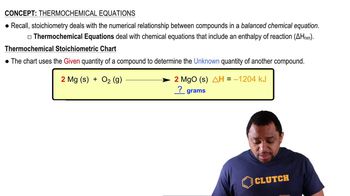
Thermochemical equations are balanced chemical equations that include the heat of reaction. They provide a quantitative measure of the energy change associated with a reaction, allowing chemists to predict how much heat will be released or absorbed under specific conditions, which is essential for practical applications in chemistry.
Recommended video:
Guided course
01:13
Thermochemical Equations