
Pearson+ LogoPearson+ Logo
Ch.8 Gases
Timberlake - Chemistry: An Introduction to General, Organic, and Biological Chemistry 13th Edition
Timberlake13th EditionChemistry: An Introduction to General, Organic, and Biological ChemistryISBN: 9780134421353Not the one you use?Change textbook
Chapter 8, Problem 42

Rearrange the variables in the combined gas law to solve for P2.

Verified step by step guidance
1
Start with the combined gas law formula: PV/T = constant. For two states, the formula becomes: P₁V₁/T₁ = P₂V₂/T₂.
Identify the variable you need to solve for, which is P₂. Rearrange the equation to isolate P₂.
Multiply both sides of the equation by T₂ to eliminate the denominator on the right-hand side: P₁V₁T₂/T₁ = P₂V₂.
Divide both sides of the equation by V₂ to isolate P₂: P₂ = (P₁V₁T₂)/(T₁V₂).
Verify that the rearranged formula makes sense by checking the units of each variable (pressure, volume, and temperature) to ensure dimensional consistency.

Verified video answer for a similar problem:

This video solution was recommended by our tutors as helpful for the problem above.
Video duration:
1m
Was this helpful?

Key Concepts

Here are the essential concepts you must grasp in order to answer the question correctly.

Combined Gas Law

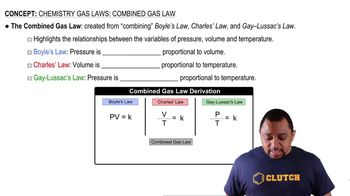
The Combined Gas Law is an equation that relates the pressure, volume, and temperature of a gas. It combines Boyle's Law, Charles's Law, and Gay-Lussac's Law into a single formula: (P₁V₁)/T₁ = (P₂V₂)/T₂. This law is essential for understanding how changes in one variable affect the others in a closed system.
Recommended video:
Guided course
01:43
Chemistry Gas Laws: Combined Gas Law

Rearranging Equations

Rearranging equations involves manipulating an equation to isolate a specific variable. This process often requires using algebraic techniques such as addition, subtraction, multiplication, and division. In the context of the Combined Gas Law, rearranging allows us to solve for P₂ by expressing it in terms of the other variables.
Recommended video:
Guided course
01:13
Thermochemical Equations

Variables in Gas Laws

In the context of gas laws, the key variables are pressure (P), volume (V), and temperature (T). Each variable plays a crucial role in determining the state of a gas. Understanding how these variables interact and affect each other is vital for solving problems related to gas behavior, such as finding P₂ in the Combined Gas Law.
Recommended video:
Guided course
01:43
Chemistry Gas Laws: Combined Gas Law