
Pearson+ LogoPearson+ Logo
Ch.8 Gases
Timberlake - Chemistry: An Introduction to General, Organic, and Biological Chemistry 13th Edition
Timberlake13th EditionChemistry: An Introduction to General, Organic, and Biological ChemistryISBN: 9780134421353Not the one you use?Change textbook
Chapter 8, Problem 44a

A sample of argon gas has a volume of 735 mL at a pressure of 1.20 atm and a temperature of 112 °C. What is the final volume of the gas, in milliliters, when the pressure and temperature of the gas sample are changed to the following, if the amount of gas does not change?
a. 658 mmHg and 281 K

Verified step by step guidance
1
Step 1: Identify the given values and convert them to appropriate units if necessary. The initial volume (V₁) is 735 mL, the initial pressure (P₁) is 1.20 atm, and the initial temperature (T₁) is 112 °C. Convert T₁ to Kelvin using the formula T(K) = T(°C) + 273.15. The final pressure (P₂) is 658 mmHg, and the final temperature (T₂) is 281 K. Convert P₂ to atm using the conversion factor 1 atm = 760 mmHg.
Step 2: Write down the combined gas law equation: PTV=PTV. Rearrange the equation to solve for the final volume (V₂): V2=P1V1T2P2T1.
Step 3: Substitute the known values into the equation. Use the converted values for T₁ (in Kelvin) and P₂ (in atm). Ensure all units are consistent: pressure in atm, volume in mL, and temperature in Kelvin.
Step 4: Perform the calculations step by step. First, calculate the numerator: multiply P₁, V₁, and T₂. Then calculate the denominator: multiply P₂ and T₁. Finally, divide the numerator by the denominator to find V₂.
Step 5: Verify the units of the final answer. The volume should be in milliliters (mL). Double-check the calculations to ensure accuracy and confirm that the result makes sense based on the given conditions.

Verified video answer for a similar problem:

This video solution was recommended by our tutors as helpful for the problem above.
Video duration:
2m
Was this helpful?

Key Concepts

Here are the essential concepts you must grasp in order to answer the question correctly.

Ideal Gas Law

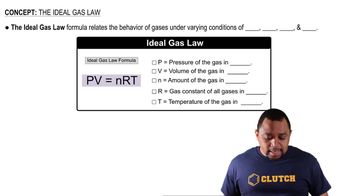
The Ideal Gas Law is a fundamental equation in chemistry that relates the pressure, volume, temperature, and number of moles of a gas. It is expressed as PV = nRT, where P is pressure, V is volume, n is the number of moles, R is the ideal gas constant, and T is temperature in Kelvin. This law allows us to predict how a gas will behave under different conditions.
Recommended video:
Guided course
01:15
The Ideal Gas Law Concept 1

Gas Laws

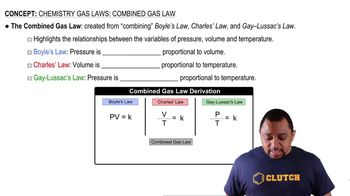
Gas laws describe the relationships between pressure, volume, and temperature of gases. Key laws include Boyle's Law (pressure and volume), Charles's Law (volume and temperature), and Gay-Lussac's Law (pressure and temperature). Understanding these laws is essential for solving problems involving changes in gas conditions, as they provide the necessary relationships to calculate unknown variables.
Recommended video:
Guided course
01:43
Chemistry Gas Laws: Combined Gas Law

Unit Conversion

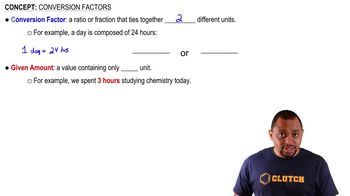
Unit conversion is the process of converting a quantity expressed in one set of units to another. In this problem, it is crucial to convert pressure from atm to mmHg and temperature from Celsius to Kelvin to ensure consistency in calculations. Mastery of unit conversion is vital for accurately applying gas laws and obtaining correct results.
Recommended video:
Guided course
01:56
Conversion Factors (Simplified) Concept 1