Ch. 19 - Disorders Associated with the Immune System
Tortora - Microbiology: An Introduction 14th Edition
Tortora14th EditionMicrobiology: An IntroductionISBN: 9780138200398Not the one you use?Change textbook
Chapter 19, Problem 2

In the laboratory, blood is typed by looking for hemagglutination. For example, anti-A antibodies and type A RBCs clump. In a type A person, anti-A antibodies will cause hemolysis. Why?

Verified step by step guidance
1
Understand the difference between hemagglutination and hemolysis: Hemagglutination is the clumping of red blood cells (RBCs) due to antibody binding, while hemolysis is the destruction or rupture of RBCs leading to the release of hemoglobin.
Recognize that in blood typing, anti-A antibodies bind specifically to A antigens on the surface of type A RBCs, causing them to clump together (hemagglutination).
Know that hemolysis occurs when the antibody binding activates the complement system, a part of the immune response that can lyse (break down) the RBC membrane.
In a type A person, the presence of anti-A antibodies leads to complement activation upon binding to A antigens on RBCs, resulting in hemolysis.
Summarize that hemolysis happens because the antibody-antigen interaction triggers complement-mediated destruction of RBCs, not just clumping.

Verified video answer for a similar problem:

This video solution was recommended by our tutors as helpful for the problem above.
Video duration:
1m
Was this helpful?

Key Concepts

Here are the essential concepts you must grasp in order to answer the question correctly.

Blood Typing and ABO Antigens

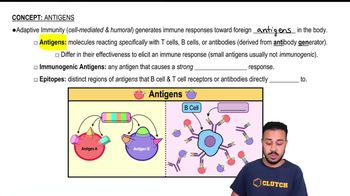
Blood typing is based on the presence of specific antigens (A or B) on the surface of red blood cells (RBCs). Type A blood has A antigens, type B has B antigens, AB has both, and O has none. The immune system produces antibodies against the antigens not present on an individual's RBCs.
Recommended video:

Hemagglutination Reaction

Hemagglutination occurs when antibodies bind to their specific antigens on RBCs, causing the cells to clump together. This clumping is used in the lab to identify blood types by mixing RBCs with known antibodies and observing agglutination patterns.
Recommended video:
Guided course
01:56
Chemical Reactions

Hemolysis Caused by Antibody Binding

When antibodies bind to RBC antigens, they can activate the complement system, leading to the destruction (hemolysis) of the RBCs. In a type A person, anti-A antibodies binding to A antigens trigger this immune response, causing hemolysis and cell damage.
Recommended video:
Guided course
09:16
Outcomes of Antibody Binding to Antigen