Ch. 9 - Principles of Infectious Disease and Epidemiology
Norman-McKay- Microbiology: Basic and Clinical Principles 2nd Edition
Norman-McKay2nd EditionMicrobiology: Basic and Clinical PrinciplesISBN: 9780137661619Not the one you use?Change textbook
Chapter 9, Problem 4

List three functions of public health.

Verified step by step guidance
1
Understand that public health focuses on protecting and improving the health of populations through organized efforts and informed choices.
Identify that one key function of public health is disease prevention, which includes activities like vaccination programs and health education to reduce the spread of infectious diseases.
Recognize that another function is health promotion, which involves encouraging healthy behaviors and environments to improve overall community well-being.
Acknowledge that public health also involves health protection, which includes enforcing regulations and policies to ensure safe food, water, and environments.
Summarize by listing these three functions: disease prevention, health promotion, and health protection, as core roles of public health systems.

Verified video answer for a similar problem:

This video solution was recommended by our tutors as helpful for the problem above.
Video duration:
2m
Was this helpful?

Key Concepts

Here are the essential concepts you must grasp in order to answer the question correctly.

Disease Prevention

Disease prevention involves measures to reduce the occurrence and spread of illnesses in populations. This includes vaccination programs, sanitation, and health education to minimize risk factors and protect community health.
Recommended video:
Guided course
04:57
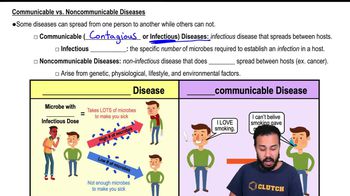
Communicable vs. Noncommunicable Diseases

Health Promotion

Health promotion focuses on encouraging healthy behaviors and lifestyles through education, policy-making, and community initiatives. It aims to improve overall well-being and prevent chronic diseases by addressing social and environmental determinants.
Recommended video:
Guided course
06:00
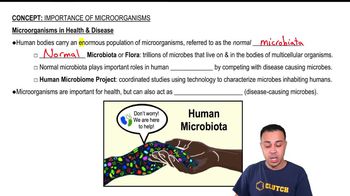
Microorganisms in Health & Disease

Health Surveillance and Monitoring

Health surveillance involves the systematic collection, analysis, and interpretation of health data to detect and respond to public health threats. Monitoring disease trends helps guide interventions and policy decisions to protect populations.
Recommended video:
Guided course
06:00
Microorganisms in Health & Disease
Related Practice
Textbook Question

Indicate the true statements and then correct the false statements, so they are true.

a. Zoonotic diseases pass from humans to animals.

b. Communicable diseases spread from person to person.

c. Noncommunicable diseases are contagious.

d. Koch’s postulates of disease are mainly used to study noninfectious diseases.

1341
views
Textbook Question

State what type of mortality rate is applicable.


Scenario 1: Out of 6,000 live births last week, 10 of the women died.

Type of mortality rate?

Scenario 2: 300 patients had disease X last year, 10 of whom died.

Type of mortality rate?

Scenario 3: Of the 120,000 live births in a particular community last year, 15 of the babies died before their first birthday.

Type of mortality rate?

Scenario 4: Out of 3,000 people in a given population, 100 died of pneumonia.

Type of mortality rate?

Calculated mortality rate (expressed per 100 in the population):

1152
views
Textbook Question

Diseases that the CDC collects information on through collaboration with state and local health authorities are called (NCLEX/HESI/TEAS)

a. Communicable diseases.

b. Reportable diseases.

c. Nationally notifiable diseases.

d. Investigative diseases.

e. Case report illnesses.

1348
views
Textbook Question

Draft a Venn diagram to compare and contrast descriptive and analytical epidemiology.

1278
views
Textbook Question

Match the following:

765
views
Textbook Question

In developed nations, which of the following are considered endemic diseases, and which are considered sporadic diseases?

Influenza: (endemic or sporadic)

Tetanus: (endemic or sporadic)

Plague: (endemic or sporadic)

Common cold: (endemic or sporadic)

Streptococcal pharyngitis: (endemic or sporadic)

Botulism: (endemic or sporadic)

Pneumonia: (endemic or sporadic)

1257
views