


Ch. 23 - Microbial Diseases of the Cardiovascular and Lymphatic Systems
Tortora - Microbiology: An Introduction 14th Edition
Tortora14th EditionMicrobiology: An IntroductionISBN: 9780138200398Not the one you use?Change textbook
Chapter 23, Problem 2

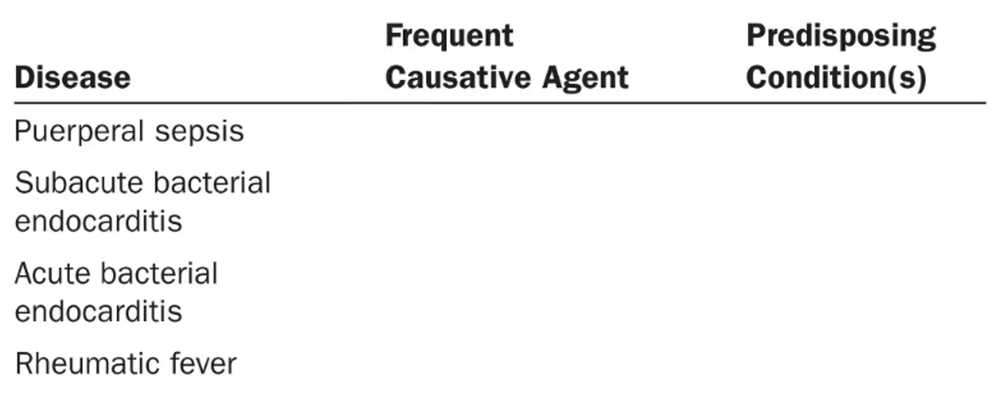
Complete the following table.
Table with columns for disease, frequent causative agent, and predisposing conditions, listing four bacterial diseases.

Verified step by step guidance
1
Identify the parameters or variables that the table requires to be completed. Typically, in microbiology, such tables might involve microbial growth phases, generation time, or population size over time.
Determine the formulas or relationships relevant to the table. For example, if the table involves bacterial growth, recall the formula for population size during exponential growth: \(N_t = N_0 \times 2^{\frac{t}{g}}\), where \(N_t\) is the population at time \(t\), \(N_0\) is the initial population, and \(g\) is the generation time.
Use the given data in the table to substitute into the formula. For each missing value, rearrange the formula if necessary to solve for the unknown (e.g., solving for \(t\) or \(g\) if those are missing).
Calculate each missing value step-by-step, ensuring units are consistent (e.g., time in minutes or hours) and that you apply the correct exponentiation for growth calculations.
Review the completed table to verify that all values are consistent with the biological context and mathematical relationships, ensuring no contradictions or errors.

Verified video answer for a similar problem:

This video solution was recommended by our tutors as helpful for the problem above.
Video duration:
3m
Was this helpful?

Key Concepts

Here are the essential concepts you must grasp in order to answer the question correctly.

Microbial Classification and Taxonomy

Understanding how microorganisms are classified based on characteristics such as shape, staining properties, and genetic makeup is essential. Taxonomy helps organize microbes into groups like bacteria, archaea, fungi, and viruses, facilitating identification and comparison.
Recommended video:
Guided course
02:19
Introduction to Taxonomy

Microscopy and Staining Techniques

Microscopy allows visualization of microbes, while staining methods like Gram staining differentiate bacteria by cell wall structure. These techniques provide critical information for completing tables related to microbial morphology and classification.
Recommended video:
Guided course
03:46
Light Microscopy: Bright-Field Microscopes

Microbial Physiology and Metabolism

Knowledge of microbial metabolic processes and physiological traits, such as oxygen requirements and nutrient utilization, is important for filling in characteristics in tables. This helps distinguish between different microbial species and their ecological roles.
Recommended video:
Guided course
02:17
Introduction to Metabolism