
Mucus-secreting membranes are found in: a. The urinary system b. The digestive cavity c. The respiratory passages d. All of the above
Verified step by step guidance
1
Understand that mucus-secreting membranes, also known as mucous membranes or mucosae, line body cavities that are exposed to the external environment and internal organs.
Recall that the urinary system has mucous membranes lining parts such as the urethra, which help protect and lubricate the passageways.
Recognize that the digestive cavity is lined with mucous membranes that secrete mucus to protect the lining and aid in the movement of food.
Know that the respiratory passages are also lined with mucous membranes that trap particles and pathogens, helping to keep the airways clear.
Conclude that since mucus-secreting membranes are present in all these systems, the correct answer is the option that includes all of them.
Verified video answer for a similar problem:
This video solution was recommended by our tutors as helpful for the problem above
Video duration:
1m
Play a video:
Was this helpful?
Key Concepts
Here are the essential concepts you must grasp in order to answer the question correctly.
Mucus-Secreting Membranes
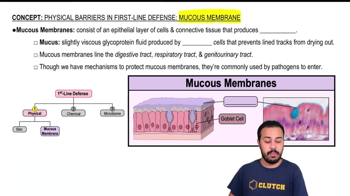
Mucus-secreting membranes, or mucous membranes, line various body cavities and canals exposed to the external environment. They produce mucus, a sticky fluid that protects and lubricates these surfaces, trapping pathogens and particles.
Mucous membranes are found in multiple systems including the respiratory passages, digestive tract, and urinary system. These membranes help protect these systems by secreting mucus to trap debris and microorganisms.
Mucus serves various protective roles such as moisturizing tissues, trapping pathogens, and facilitating the movement of materials. In the respiratory system, it traps dust; in the digestive system, it protects lining from acids; and in the urinary system, it prevents infections.