Pearson+ LogoPearson+ Logo
Ch. 14 - Infection, Infectious Diseases, and Epidemiology
Bauman - Microbiology with Diseases by Taxonomy 6th Edition
Bauman6th EditionMicrobiology with Diseases by TaxonomyISBN: 9780134832302Not the one you use?Change textbook
Chapter 14, Problem 6

Nonliving reservoirs of disease, such as a toothbrush, drinking glass, and needle, are called __________ .

Verified step by step guidance
1
Understand the concept of reservoirs in microbiology: reservoirs are sources where pathogens can live, multiply, and from which they can be transmitted to a host.
Differentiate between living and nonliving reservoirs: living reservoirs include humans and animals, while nonliving reservoirs are inanimate objects that can harbor pathogens.
Recall the specific term used for nonliving reservoirs of disease, which includes objects like toothbrushes, drinking glasses, and needles.
Identify that these nonliving reservoirs are commonly referred to as "fomites."
Conclude that the correct term to fill in the blank is "fomites," which are inanimate objects capable of transmitting infectious agents.

Verified video answer for a similar problem:

This video solution was recommended by our tutors as helpful for the problem above.
Video duration:
2m
Was this helpful?

Key Concepts

Here are the essential concepts you must grasp in order to answer the question correctly.

Fomites

Fomites are nonliving objects or materials that can carry infectious agents and facilitate their transmission. Examples include toothbrushes, drinking glasses, and needles, which can harbor pathogens and contribute to the spread of disease.

Reservoirs of Infection

Reservoirs of infection are sources where pathogens normally live, multiply, and from which they can be transmitted to a host. These can be living organisms or nonliving objects (fomites) that maintain the pathogen in the environment.
Recommended video:
Guided course
03:52
Map of Lesson on Bacteriophage Infections

Modes of Disease Transmission

Modes of disease transmission describe how pathogens spread from reservoirs to new hosts. Indirect contact transmission involves fomites, where pathogens are transferred via contaminated objects rather than direct person-to-person contact.
Recommended video:
Guided course
04:57
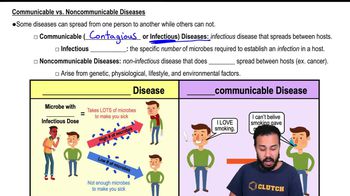
Communicable vs. Noncommunicable Diseases