Pearson+ LogoPearson+ Logo
Ch. 5 - Microbial Metabolism
Bauman - Microbiology with Diseases by Taxonomy 6th Edition
Bauman6th EditionMicrobiology with Diseases by TaxonomyISBN: 9780134832302Not the one you use?Change textbook
Chapter 5, Problem 10

Activation energy ______.
a. Is the amount of energy required during an activity such as flagellar motion
b. Requires the addition of nutrients in the presence of water
c. Is lowered by the action of organic catalysts
d. Results from the movement of molecules

Verified step by step guidance
1
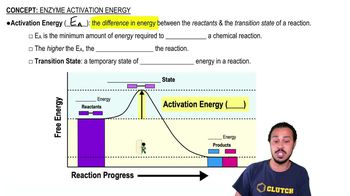
Understand the concept of activation energy: it is the minimum amount of energy required to start a chemical reaction.
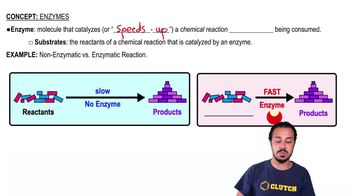
Recall that enzymes, which are organic catalysts, function by lowering the activation energy needed for biochemical reactions.
Analyze each option in the context of activation energy: option (a) refers to energy during activity, (b) mentions nutrients and water, (c) involves organic catalysts, and (d) relates to molecular movement.
Identify that activation energy is specifically related to the energy barrier in chemical reactions and how catalysts affect it.
Conclude that the correct description of activation energy is that it is lowered by the action of organic catalysts, which corresponds to option (c).

Verified video answer for a similar problem:

This video solution was recommended by our tutors as helpful for the problem above.
Video duration:
1m
Was this helpful?

Key Concepts

Here are the essential concepts you must grasp in order to answer the question correctly.

Activation Energy

Activation energy is the minimum amount of energy needed to start a chemical reaction. It represents the energy barrier that reactants must overcome to be transformed into products. Without sufficient activation energy, reactions proceed very slowly or not at all.
Recommended video:
Guided course
04:18
Enzyme Activation Energy

Role of Organic Catalysts (Enzymes)

Organic catalysts, such as enzymes, speed up chemical reactions by lowering the activation energy required. They provide an alternative reaction pathway, allowing reactions to occur more efficiently at lower energy levels, which is essential for biological processes.
Recommended video:

Energy and Molecular Movement

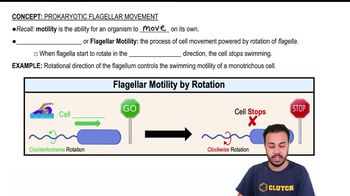
Molecular movement, such as diffusion or thermal motion, involves kinetic energy but does not directly define activation energy. While molecular motion can influence reaction rates, activation energy specifically refers to the energy threshold for initiating a reaction.
Recommended video:
Guided course
02:43
Prokaryotic Flagellar Movement