Ch. 6 - Viruses and Prions
Chapter 6, Problem 7

The patient has a viral titer of 200 on day four after infection, 30 at 4 weeks after infection, 600 at 8 months after infection, and 23 after 1 year of infection. This is likely a(n) _______________ infection.

Verified step by step guidance
1
Step 1: Understand the meaning of viral titer values over time. Viral titer measures the concentration of virus particles in a sample, indicating the level of active infection at different time points.
Step 2: Analyze the pattern of viral titers given: 200 on day 4, 30 at 4 weeks, 600 at 8 months, and 23 at 1 year. Notice the initial decrease, then a significant increase, followed by another decrease.
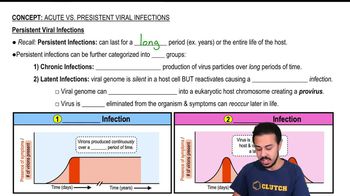
Step 3: Recall the types of viral infections: acute (rapid onset and clearance), latent (virus remains dormant with possible reactivation), and chronic (persistent presence of virus at varying levels).
Step 4: Compare the pattern to these infection types. The increase in viral titer at 8 months after a decrease suggests reactivation of the virus, which is characteristic of a latent infection.
Step 5: Conclude that the infection is likely a latent infection, where the virus remains in the host and can reactivate after a period of dormancy.

Verified video answer for a similar problem:

This video solution was recommended by our tutors as helpful for the problem above.
Video duration:
4m
Was this helpful?

Key Concepts

Here are the essential concepts you must grasp in order to answer the question correctly.

Viral Titer and Its Significance

Viral titer measures the concentration of virus particles in a sample, indicating the level of viral replication or presence in the host. Changes in viral titer over time help assess infection dynamics, such as acute, chronic, or latent infections.
Recommended video:
Guided course
05:12
Persistent Viral Infections

Types of Viral Infections

Viral infections can be acute (rapid onset and resolution), chronic (persistent with ongoing replication), or latent (virus remains dormant with occasional reactivation). Understanding these types helps interpret fluctuating viral titers in patients.
Recommended video:
Guided course
05:12
Persistent Viral Infections

Interpreting Viral Titer Fluctuations Over Time

An initial rise, decline, and later increase in viral titer suggests viral reactivation or persistence rather than clearance. This pattern is typical of latent infections with periodic reactivation, distinguishing them from purely acute or chronic infections.
Recommended video:
Guided course
02:54
Generation Times