Ch. 8 - Microbial Metabolism
Norman-McKay- Microbiology: Basic and Clinical Principles 2nd Edition
Norman-McKay2nd EditionMicrobiology: Basic and Clinical PrinciplesISBN: 9780137661619Not the one you use?Change textbook
Chapter 8, Problem 6

Indicate which statements about fermentation are true, and then correct the false statements.
a. Fermentation is an anaerobic process that can be used by prokaryotic or eukaryotic cells.
b. Sugars are the only nutrients that can be fermented.
c. Fermentation is a low ATP yielding process.
d. There are only five types of fermentation: homolactic, heterolactic, alcohol, mixed acid, and butanediol fermentation.
e. Fermentation is the same as anaerobic respiration.

Verified step by step guidance
1
Step 1: Analyze statement (a): "Fermentation is an anaerobic process that can be used by prokaryotic or eukaryotic cells." Understand that fermentation occurs in the absence of oxygen (anaerobic) and is indeed used by both prokaryotic (like bacteria) and eukaryotic cells (like yeast). This statement is true.
Step 2: Analyze statement (b): "Sugars are the only nutrients that can be fermented." Recall that while sugars are the most common substrates for fermentation, other organic molecules such as amino acids and organic acids can also be fermented by certain microorganisms. Therefore, this statement is false. Correct it by stating: "Sugars are the most common, but not the only, nutrients that can be fermented."
Step 3: Analyze statement (c): "Fermentation is a low ATP yielding process." Remember that fermentation produces ATP only through substrate-level phosphorylation and yields much less ATP compared to aerobic respiration. This statement is true.
Step 4: Analyze statement (d): "There are only five types of fermentation: homolactic, heterolactic, alcohol, mixed acid, and butanediol fermentation." Recognize that these are common types, but fermentation pathways are diverse and more than these five types exist. Thus, this statement is false. Correct it by stating: "There are multiple types of fermentation beyond just these five, including others depending on the organism and substrates."
Step 5: Analyze statement (e): "Fermentation is the same as anaerobic respiration." Understand that fermentation and anaerobic respiration differ: fermentation does not use an electron transport chain or external electron acceptors, whereas anaerobic respiration uses an electron transport chain with a terminal electron acceptor other than oxygen. Therefore, this statement is false. Correct it by stating: "Fermentation is different from anaerobic respiration; fermentation does not involve an electron transport chain or external electron acceptors."

Verified video answer for a similar problem:

This video solution was recommended by our tutors as helpful for the problem above.
Video duration:
3m
Was this helpful?

Key Concepts

Here are the essential concepts you must grasp in order to answer the question correctly.

Fermentation as an Anaerobic Process

Fermentation is a metabolic process that occurs in the absence of oxygen, allowing cells to generate energy anaerobically. Both prokaryotic and eukaryotic cells can perform fermentation, using organic molecules as electron acceptors to regenerate NAD+ for glycolysis.
Recommended video:
Guided course
03:35
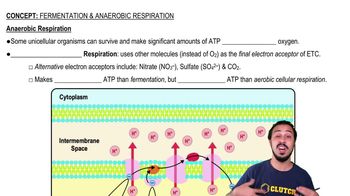
Anaerobic Respiration

Substrates and Types of Fermentation

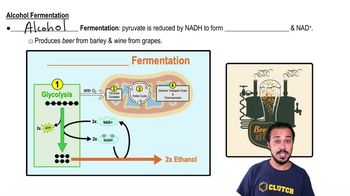
Fermentation is not limited to sugars; various organic compounds like amino acids and organic acids can also be fermented. Additionally, fermentation encompasses many types beyond the commonly known five, including lactic acid, alcohol, mixed acid, butanediol, and others, reflecting diverse metabolic pathways.
Recommended video:
Guided course
02:02
Alcohol Fermentation

Difference Between Fermentation and Anaerobic Respiration

Fermentation differs from anaerobic respiration in that it does not use an electron transport chain or external electron acceptors like nitrate or sulfate. Instead, fermentation relies on substrate-level phosphorylation for ATP production, resulting in lower energy yield compared to anaerobic respiration.
Recommended video:
Guided course
03:35
Anaerobic Respiration