
Pearson+ LogoPearson+ Logo
Ch. 6 - Microbial Growth
Tortora - Microbiology: An Introduction 14th Edition
Tortora14th EditionMicrobiology: An IntroductionISBN: 9780138200398Not the one you use?Change textbook
Chapter 6, Problem 8

Differentiate complex and chemically defined media.

Verified step by step guidance
1
Step 1: Understand that culture media are substances used to grow microorganisms in the lab, providing necessary nutrients for their growth.
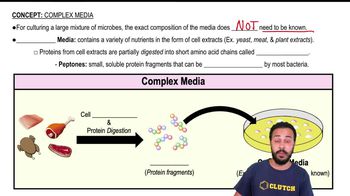
Step 2: Define complex media as those that contain ingredients of unknown exact chemical composition, such as yeast extract, peptones, or beef extract, which provide a rich mixture of nutrients.
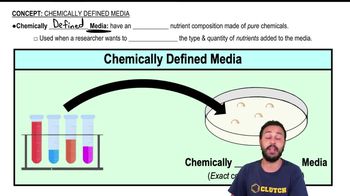
Step 3: Define chemically defined media as those where all the chemical components and their exact concentrations are known, typically consisting of pure chemicals like glucose, salts, and amino acids.
Step 4: Compare the two by noting that complex media are easier to prepare and support the growth of a wide variety of organisms, but their exact nutrient content is variable and unknown, whereas chemically defined media allow precise control over nutrient composition, useful for studying specific nutritional requirements.
Step 5: Summarize that the key difference lies in the known versus unknown chemical composition of the media components, affecting their use in microbiological experiments.

Verified video answer for a similar problem:

This video solution was recommended by our tutors as helpful for the problem above.
Video duration:
2m
Was this helpful?

Key Concepts

Here are the essential concepts you must grasp in order to answer the question correctly.

Complex Media

Complex media contain nutrient-rich ingredients like yeast extract, peptones, or meat extracts, whose exact chemical composition is unknown. They support the growth of a wide variety of microorganisms and are commonly used when specific nutritional requirements are not needed.
Recommended video:
Guided course
02:59
Complex Media

Chemically Defined Media

Chemically defined media have precisely known chemical compositions with all components measured and specified. They are used to study the nutritional needs of microorganisms or to grow organisms with specific metabolic requirements.
Recommended video:
Guided course
01:53
Chemically Defined Media

Applications and Differences

The main difference lies in composition knowledge: complex media are undefined but rich, while defined media are exact and controlled. Complex media are easier to prepare and support diverse growth, whereas defined media allow for controlled experiments on microbial metabolism.
Recommended video:
Guided course
05:32
Reviewing the Different Types of Microscopes