
Pearson+ LogoPearson+ Logo
Ch. 13 - Viruses, Viroids, and Prions
Tortora - Microbiology: An Introduction 14th Edition
Tortora14th EditionMicrobiology: An IntroductionISBN: 9780138200398Not the one you use?Change textbook
Chapter 13, Problem 8

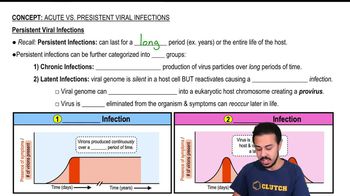
Persistent viral infections such as (a) ________ might be caused by (b) ________ that are (c) ________.

Verified step by step guidance
1
Step 1: Understand the concept of persistent viral infections. These are infections where the virus remains in the host for a long period, often without causing immediate symptoms, and can evade the immune system.
Step 2: Identify examples of persistent viral infections. Common examples include viruses like HIV, herpes simplex virus (HSV), and hepatitis B virus (HBV).
Step 3: Recognize the cause of persistent infections. These infections are often caused by viruses that can integrate into the host genome or establish latency, allowing them to persist.
Step 4: Define the nature of the viruses causing persistence. Such viruses are typically described as latent or slow-replicating, meaning they can remain dormant or replicate at low levels to avoid immune detection.
Step 5: Summarize the answer by filling in the blanks: (a) an example of a persistent viral infection, (b) the type of virus causing it, and (c) the characteristic of the virus that allows persistence.

Verified video answer for a similar problem:

This video solution was recommended by our tutors as helpful for the problem above.
Video duration:
3m
Was this helpful?

Key Concepts

Here are the essential concepts you must grasp in order to answer the question correctly.

Persistent Viral Infections

Persistent viral infections occur when a virus remains in the host for extended periods, often evading the immune system. These infections can be latent or chronic, causing ongoing or recurring symptoms, as seen in diseases like HIV or herpes simplex virus.
Recommended video:
Guided course
05:12
Persistent Viral Infections

Viral Pathogens

Viral pathogens are viruses that cause disease by infecting host cells and replicating within them. Understanding the specific virus involved is crucial, as different viruses have unique mechanisms for persistence and immune evasion.
Recommended video:
Guided course
03:40
Introduction to Pathogenic Toxins

Mechanisms of Viral Persistence

Viruses persist by mechanisms such as latency, immune system evasion, or integration into the host genome. These strategies allow viruses to avoid clearance, maintain infection, and sometimes reactivate, contributing to chronic disease.
Recommended video:
Guided course
05:12
Persistent Viral Infections
Related Practice
Textbook Question

The ability of a virus to infect an organism is regulated by

a. the host species.

b. the type of cells.

c. the availability of an attachment site.

d. cell factors necessary for viral replication.

e. all of the above

694
views
Textbook Question

Recall from Chapter 1 that Koch's postulates are used to determine the etiology of a

disease. Why is it difficult to determine the etiology of

a. a viral infection, such as influenza?

b. cancer?

644
views
Textbook Question

Which of the following statements is false?

a. Viruses contain DNA or RNA.

b. The nucleic acid of a virus is surrounded by a protein coat.

c. Viruses multiply inside living cells using viral mRNA, tRNA, and ribosomes.

d. Viruses cause the synthesis of specialized infectious elements.

e. Viruses multiply inside living cells.

682
views
Textbook Question

Place the following in the order in which they are found in a host cell: (1) capsid proteins;

(2) infective phage particles; (3) phage nucleic acid.

a. 1, 2, 3

b. 3, 2, 1

c. 2, 1,3

d. 3, 1, 2

e. 1, 3, 2

476
views
Textbook Question

Plant viruses can’t penetrate intact plant cells because (a) ________; therefore, they enter cells by (b) ________. Plant viruses can be cultured in (c) ________.

540
views
Textbook Question

Which of the following does not initiate DNA synthesis?

a. A double-stranded DNA virus (Poxviridae)

b. A DNA virus with reverse transcriptase (Hepadnaviridae)

c. An RNA virus with reverse transcriptase (Retroviridae)

d. A single-stranded RNA virus (Togaviridae)

e. None of the above

552
views