Pearson+ LogoPearson+ Logo
Ch. 3 - Observing Microorganisms Through a Microscope
Tortora - Microbiology: An Introduction 14th Edition
Tortora14th EditionMicrobiology: An IntroductionISBN: 9780138200398Not the one you use?Change textbook
Chapter 3, Problem 5

The maximum magnification of a compound microscope is (a) ________; that of an electron microscope, (b) ________. The maximum resolution of a compound microscope is (c) ________; that of an electron microscope, (d) ________. One advantage of a scanning electron microscope over a transmission electron microscope is (e) ________.

Verified step by step guidance
1
Step 1: Understand the concept of magnification in microscopes. Magnification refers to how much larger an image appears compared to the actual size of the specimen. For a compound light microscope, the maximum magnification is typically limited by the optical system and is usually around 1000x to 2000x. For an electron microscope, which uses electron beams instead of light, the magnification can be much higher, often up to 1,000,000x or more.
Step 2: Understand the concept of resolution. Resolution is the ability of a microscope to distinguish two points as separate entities. It depends on the wavelength of the illumination source. For a compound light microscope, the maximum resolution is limited by the wavelength of visible light, typically around 200 nanometers (0.2 micrometers). For an electron microscope, because electrons have much shorter wavelengths, the resolution can be as fine as 0.1 nanometers or better.
Step 3: Recall the difference between scanning electron microscope (SEM) and transmission electron microscope (TEM). TEM passes electrons through a thin specimen to form an image, providing detailed internal structure. SEM scans the surface with electrons and collects secondary electrons emitted from the surface, producing detailed 3D surface images.
Step 4: Identify the advantage of SEM over TEM. SEM provides detailed three-dimensional images of the surface topography of specimens, which TEM cannot do because TEM images are two-dimensional and show internal structures.
Step 5: Summarize the answers by filling in the blanks: (a) maximum magnification of compound microscope, (b) maximum magnification of electron microscope, (c) maximum resolution of compound microscope, (d) maximum resolution of electron microscope, and (e) advantage of SEM over TEM.

Verified video answer for a similar problem:

This video solution was recommended by our tutors as helpful for the problem above.
Video duration:
2m
Was this helpful?

Key Concepts

Here are the essential concepts you must grasp in order to answer the question correctly.

Magnification in Microscopy

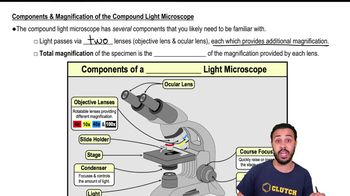
Magnification refers to how much larger an image appears compared to the actual size of the specimen. Compound light microscopes typically magnify up to 1000-2000 times, while electron microscopes can magnify up to 1,000,000 times or more, allowing visualization of much smaller structures.
Recommended video:
Guided course
06:15
Components & Magnification of the Compound Light Microscope

Resolution in Microscopy

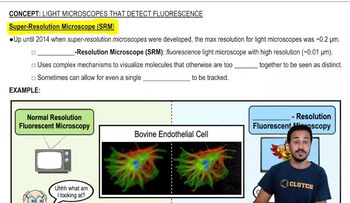
Resolution is the ability of a microscope to distinguish two close points as separate. Compound microscopes have a resolution limit of about 200 nanometers due to light wavelength, whereas electron microscopes achieve much higher resolution (around 0.1 nanometers) because electrons have shorter wavelengths.
Recommended video:
Guided course
03:16
Super-Resolution Microscope (SRM)

Differences Between Scanning and Transmission Electron Microscopes

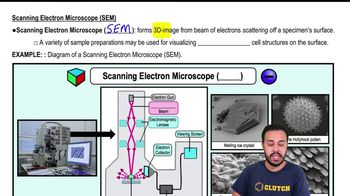
Scanning electron microscopes (SEM) provide detailed 3D surface images by scanning the specimen with electrons, while transmission electron microscopes (TEM) produce 2D images by transmitting electrons through thin samples. SEM is advantageous for studying surface topography and texture.
Recommended video:
Guided course
02:54
Scanning Electron Microscope (SEM)