
Textbook Question
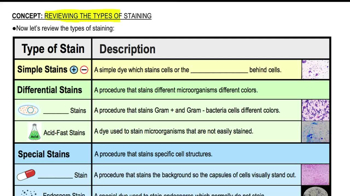
What is the purpose of a counterstain in the acid-fast stain?
1768
views

 Verified step by step guidance
 06:04
06:04
 04:11
04:11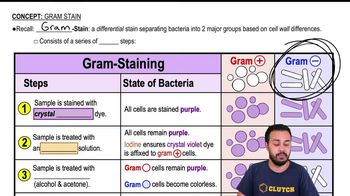 04:57
04:57What is the purpose of a counterstain in the acid-fast stain?
Why is a mordant used in the Gram stain? In the flagella stain?
Which of the following pairs is mismatched?
a. Capsule—negative stain
b. Cell arrangement—simple stain
c. Cell size—negative stain
d. Gram stain—bacterial identification
e. None of the above
The maximum magnification of a compound microscope is (a) ________; that of an electron microscope, (b) ________. The maximum resolution of a compound microscope is (c) ________; that of an electron microscope, (d) ________. One advantage of a scanning electron microscope over a transmission electron microscope is (e) ________.
Looking at the cell of a photosynthetic microorganism, you observe the chloroplasts are green in brightfield microscopy and red in fluorescence microscopy. You conclude:
a. Chlorophyll is fluorescent
b. The magnification has distorted the image
c. You’re not looking at the same structure in both microscopes
d. The stain masked the green color
e. None of the above
Calculate the total magnification of the nucleus of a cell being observed through a compound light microscope with a 10x ocular lens and an oil immersion lens.