

Ch 29: The Magnetic Field
Knight Calc - Physics for Scientists and Engineers 5th Edition
Knight Calc5th EditionPhysics for Scientists and EngineersISBN: 9780137344796Not the one you use?Change textbook
Chapter 29, Problem 77c

A wire along the x-axis carries current I in the negative x-direction through the magnetic field B={B0xlk^0xl0elsewhere\(\vec{B}\)= \(\begin{cases}\) B_0\(\dfrac{x}{l}\]\hat{k}\) & 0 \(\leq\) x \(\leq\) l \\ 0 & \(\text{elsewhere}\) \(\end{cases}\). Find an expression for the net torque on the wire about the point x = 0.

Verified step by step guidance
1
Step 1: Understand the problem. The wire carries a current I in the negative x-direction and is placed in a magnetic field that varies with position. The magnetic field is given as \( \vec{B} = \begin{cases} B_0 \frac{x}{l} \hat{k} & 0 \leq x \leq l \\ 0 & \text{elsewhere} \end{cases} \). We need to find the net torque on the wire about the point \( x = 0 \).
Step 2: Recall the formula for the magnetic force on a current-carrying wire. The differential force on a small segment of the wire is \( d\vec{F} = I (d\vec{l} \times \vec{B}) \), where \( d\vec{l} \) is the vector representing the length of the wire segment and \( \vec{B} \) is the magnetic field.
Step 3: Express the torque. Torque \( \vec{\tau} \) about a point is given by \( \vec{\tau} = \vec{r} \times \vec{F} \), where \( \vec{r} \) is the position vector of the wire segment relative to the point of rotation. For a differential segment, the torque is \( d\vec{\tau} = \vec{r} \times d\vec{F} \).
Step 4: Set up the integral for the net torque. The wire lies along the x-axis, so \( d\vec{l} = dx \hat{i} \) and \( \vec{r} = x \hat{i} \). Substituting these into the expressions for \( d\vec{F} \) and \( d\vec{\tau} \), we get \( d\vec{F} = I (dx \hat{i} \times \vec{B}) \) and \( d\vec{\tau} = \vec{r} \times d\vec{F} \). Integrate \( d\vec{\tau} \) over the range \( 0 \leq x \leq l \).
Step 5: Perform the cross products and simplify. Substitute \( \vec{B} = B_0 \frac{x}{l} \hat{k} \) into the expressions. Compute \( \hat{i} \times \hat{k} \) and \( \vec{r} \times d\vec{F} \). The integral becomes \( \vec{\tau} = \int_{0}^{l} x \cdot I \cdot B_0 \frac{x}{l} dx \hat{j} \). Simplify the integral to find the expression for the net torque.

Verified video answer for a similar problem:

This video solution was recommended by our tutors as helpful for the problem above.
Was this helpful?

Key Concepts

Here are the essential concepts you must grasp in order to answer the question correctly.

Magnetic Field

A magnetic field is a vector field that describes the magnetic influence on moving electric charges, electric currents, and magnetic materials. In this problem, the magnetic field \\vec{B} varies with position along the x-axis, being proportional to the distance x within the specified range. Understanding how the magnetic field interacts with the current in the wire is crucial for calculating the resulting forces and torques.
Recommended video:
Guided course
05:30
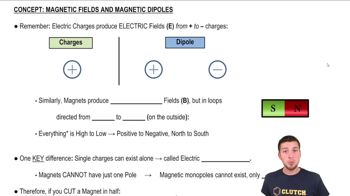
Magnetic Fields and Magnetic Dipoles

Torque

Torque is a measure of the rotational force acting on an object, defined as the product of the force and the distance from the pivot point to the line of action of the force. In this scenario, the torque on the wire is generated by the magnetic force acting on the current-carrying wire, and it is calculated about the point x = 0. The direction and magnitude of the torque depend on both the current direction and the magnetic field configuration.
Recommended video:
Guided course
08:55
Net Torque & Sign of Torque

Lorentz Force

The Lorentz force is the force experienced by a charged particle moving through a magnetic field, given by the equation \\vec{F} = q(\\vec{v} imes \\vec{B}) for a charge q moving with velocity \\vec{v}. In this case, the current in the wire can be treated as a series of moving charges, and the magnetic field will exert a force on these charges, contributing to the net torque on the wire. Understanding this force is essential for deriving the expression for torque.
Recommended video:
Guided course
13:39
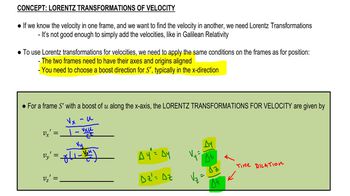
Lorentz Transformations of Velocity
Related Practice
Textbook Question

It is shown in more advanced courses that charged particles in circular orbits radiate electromagnetic waves, called cyclotron radiation. As a result, a particle undergoing cyclotron motion with speed v is actually losing kinetic energy at the ratedKdt=(μ0q46πcm2)B2v2\(\frac{dK}{dt}\) = - \(\left\)( \(\frac{\mu_0 q^4}{6\pi c m^2}\) \(\right\)) B^2 v^2

How long does it take (a) an electron and (b) a proton to radiate away half its energy while spiraling in a 2.0 T magnetic field?

217
views
Textbook Question

A scientist measuring the resistivity of a new metal alloy left her ammeter in another lab, but she does have a magnetic field probe. So she creates a 6.5-m-long, 2.0-mm-diameter wire of the material, connects it to a 1.5 V battery, and measures a 3.0 mT magnetic field 1.0 mm from the surface of the wire. What is the material's resistivity?

66
views
Textbook Question

FIGURE CP29.79 is an edge view of a 2.0 kg square loop, 2.5 m on each side, with its lower edge resting on a frictionless, horizontal surface. A 25 A current is flowing around the loop in the direction shown. What is the strength of a uniform, horizontal magnetic field for which the loop is in static equilibrium at the angle shown?

205
views
Textbook Question

Determine the field strength at the center of a current-carrying square loop having sides of length 2R.

251
views
Textbook Question

An electromagnetic rail gun uses magnetic forces to launch projectiles. FIGURE P29.76 shows a 10-cm-long, 10 g metal wire that can slide without friction along 1.0-m-long horizontal rails. The rails are connected to a 300 V source, and a 0.10 T magnetic field fills the space between the rails. Each rail has linear resistivity ⋋ = 0.10 Ω/m, which means that the resistance is ⋋ multiplied by the length of rail through which current flows. Assume that the sliding wire and the left end, where the voltage source is, have zero resistance. The wire is initially placed at x₀ = 5.0 cm then the switch is closed. What is the wire's speed as it leaves the rails?

1050
views
Textbook Question

In FIGURE P29.75, a long, straight, current-carrying wire of linear mass density μ is suspended by threads. A magnetic field perpendicular to the wire exerts a horizontal force that deflects the wire to an equilibrium angle θ. Find an expression for the strength and direction of the magnetic field B.

495
views