



Ch. 33 - Lenses and Optical Instruments
Giancoli Douglas - Physics for Scientists and Engineers 5th edition
Giancoli Douglas5th editionPhysics for Scientists and EngineersISBN: 9780137488179Not the one you use?Change textbook
Chapter 32, Problem 16

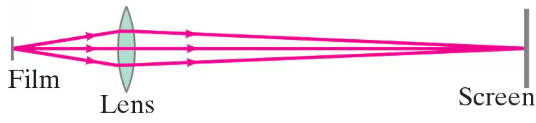
(II) In a film projector, the film acts as the object whose image is projected on a screen (Fig. 33–46). If a 105-mm-focal-length lens is to project an image on a screen 22.5 m away, how far from the lens should the film be? If the film is 24 mm wide, how wide will the picture be on the screen?

Verified step by step guidance
1
Step 1: Identify the lens equation to relate the focal length (f), object distance (d_o), and image distance (d_i). The lens equation is given as: 1f=1do+1di. Here, f = 105 mm and d_i = 22.5 m (convert to mm: 22,500 mm).
Step 2: Rearrange the lens equation to solve for the object distance (d_o): do=11f-1di. Substitute the values of f and d_i into the equation.
Step 3: Calculate the magnification (M) of the lens, which is the ratio of the image height to the object height. The formula for magnification is: M=dido. Use the values of d_i and d_o obtained from the previous steps.
Step 4: Determine the width of the picture on the screen. The image width is given by: ImageWidth=M×ObjectWidth. Here, the object width is 24 mm, and M is the magnification calculated in Step 3.
Step 5: Verify the units and ensure all values are consistent (e.g., mm for distances and widths). Interpret the results to confirm the object distance and the image width on the screen.

Verified video answer for a similar problem:

This video solution was recommended by our tutors as helpful for the problem above.
Video duration:
6m
Was this helpful?

Key Concepts

Here are the essential concepts you must grasp in order to answer the question correctly.

Lens Formula

The lens formula relates the object distance (u), image distance (v), and focal length (f) of a lens through the equation 1/f = 1/v + 1/u. This formula is essential for determining the position of the film relative to the lens in a projector setup, allowing us to calculate how far the film should be placed to achieve a clear image on the screen.
Recommended video:
05:38
Lens Maker Equation

Magnification

Magnification in optics refers to the ratio of the height of the image to the height of the object, and it can also be expressed as the ratio of the image distance to the object distance (M = v/u). Understanding magnification is crucial for determining how the size of the projected image on the screen relates to the size of the film, which is necessary for calculating the width of the picture.
Recommended video:
09:03
Mirror Equation

Image Formation

Image formation by a lens involves the process of light rays converging to create a visible image. In the context of a projector, the lens focuses light from the film onto the screen, and the characteristics of the image, such as size and clarity, depend on the distances involved and the properties of the lens. This concept is fundamental for understanding how the film's dimensions affect the projected image.
Recommended video:
05:51
Refraction at Spherical Surfaces
Related Practice
Textbook Question

Two 28.0-cm-focal-length converging lenses are placed 16.5 cm apart. An object is placed 35.0 cm in front of one lens.

(a) Where will the final image formed by the second lens be located?

(b) What is the total magnification?

1251
views
Textbook Question

It is desired to magnify reading material by a factor of 3.0 x when a book is placed 9.0 cm behind a lens.

(a) Draw a ray diagram and describe the type of image this would be.

(b) What type of lens is needed?

(c) What is the power of the lens in diopters?

1355
views
Textbook Question

(III) A bright object is placed on one side of a converging lens of focal length f, and a white screen for viewing the image is on the opposite side. The distance dT = di + do between the object and the screen is kept fixed, but the lens can be moved. Determine a formula for the distance between the two lens positions in part (a), and the ratio of the image sizes.

1196
views
Textbook Question

A 105-mm-focal-length lens is used to focus an image on the sensor of a camera. The maximum distance allowed between the lens and the sensor plane is 132 mm.

(a) How far in front of the sensor should the lens (assumed thin) be positioned if the object to be photographed is 10.0 m away? (b) 3.0 m away? (c) 1.0 m away?

(d) What is the closest object this lens could photograph sharply?

1396
views
Textbook Question

A diverging lens with ƒ = -36.5 cm is placed 14.0 cm behind a converging lens with ƒ = 20.0cm. Where will an object at infinity be focused?

1771
views
Textbook Question

An object is located 1.35 m from an 8.0-D lens. By how much does the image move if the object is moved (a) 0.90 m closer to the lens, and (b) 0.90 m farther from the lens?

1268
views