Ch 28: Fundamentals of Circuits
Knight Calc - Physics for Scientists and Engineers 5th Edition
Knight Calc5th EditionPhysics for Scientists and EngineersISBN: 9780137344796Not the one you use?Change textbook
Chapter 28, Problem 32

Show that the product RC has units of s.

Verified step by step guidance
1
Start by identifying the components of the product RC. Here, R represents resistance, and C represents capacitance. Resistance (R) is measured in ohms (Ω), and capacitance (C) is measured in farads (F).
Express the units of resistance (Ω) in terms of base SI units. Resistance is defined as voltage divided by current, so 1 Ω = 1 V / 1 A. Using the definitions of voltage (V = J/C) and current (A = C/s), we can rewrite 1 Ω as 1 (J/C) / (C/s) = 1 (kg·m²/s³·A) / (A·s) = 1 kg·m²/(s³·A²).
Express the units of capacitance (F) in terms of base SI units. Capacitance is defined as charge per unit voltage, so 1 F = 1 C / 1 V. Using the definition of voltage (V = J/C), we can rewrite 1 F as 1 C / (J/C) = 1 C² / J = 1 C² / (kg·m²/s²) = 1 s⁴·A² / (kg·m²).
Multiply the units of resistance (R) and capacitance (C) together. Substituting the derived units: (kg·m²/s³·A²) × (s⁴·A² / kg·m²) = s.
Conclude that the product RC has the units of seconds (s), as shown by the dimensional analysis.

Verified video answer for a similar problem:

This video solution was recommended by our tutors as helpful for the problem above.
Was this helpful?

Key Concepts

Here are the essential concepts you must grasp in order to answer the question correctly.

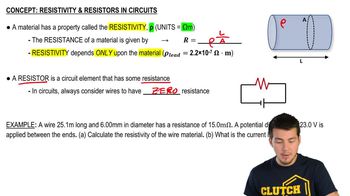
Resistance (R)

Resistance is a measure of the opposition to the flow of electric current in a circuit, measured in ohms (Ω). One ohm is defined as the resistance that allows one volt (V) to produce one ampere (A) of current. Understanding resistance is crucial for analyzing how it affects the time constant in RC circuits.
Recommended video:
Guided course
05:25
Resistivity & Resistors in Circuits

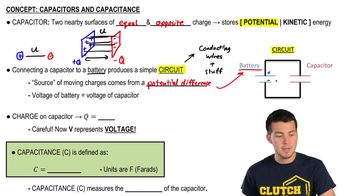
Capacitance (C)

Capacitance is the ability of a system to store an electric charge, measured in farads (F). One farad is defined as the capacitance that allows one coulomb (C) of charge to build up with a potential difference of one volt (V). The capacitance value is essential for determining how quickly a capacitor charges or discharges in an RC circuit.
Recommended video:
Guided course
08:02
Capacitors & Capacitance (Intro)

Time Constant (τ)

The time constant (τ) in an RC circuit is the product of resistance (R) and capacitance (C), expressed as τ = RC. It represents the time required for the voltage across the capacitor to reach approximately 63.2% of its final value during charging or to fall to about 36.8% during discharging. The units of τ are seconds (s), indicating that the product RC must also have units of seconds.
Recommended video:
Guided course
08:59
Phase Constant of a Wave Function