Ch 36: Special Relativity
Knight Calc - Physics for Scientists and Engineers 5th Edition
Knight Calc5th EditionPhysics for Scientists and EngineersISBN: 9780137344796Not the one you use?Change textbook
Chapter 36, Problem 7

Your job is to synchronize the clocks in a reference frame. You are going to do so by flashing a light at the origin at t = 0 s. To what time should the clock at (x, y, z) = (30 m, 40 m, 0 m) be preset?

Verified step by step guidance
1
Understand the problem: The goal is to synchronize clocks in a reference frame by accounting for the time it takes for light to travel from the origin to the point (x, y, z). Light travels at a constant speed, c = 3 × 10^8 m/s, in a vacuum. The clock at (30 m, 40 m, 0 m) should be preset to account for this travel time.
Calculate the distance from the origin to the point (30 m, 40 m, 0 m) using the Pythagorean theorem. The distance d is given by: 302+402.
Simplify the expression for the distance: 900+1600. This gives the total distance d in meters.
Determine the time it takes for light to travel this distance. The time t is given by: dc, where d is the distance calculated in the previous step and c is the speed of light (3 × 10^8 m/s).
Preset the clock at (30 m, 40 m, 0 m) to the negative of this time value, since the light flash occurs at t = 0 s and the clock must account for the time it takes for the light to reach it. This ensures synchronization with the origin clock.

Verified video answer for a similar problem:

This video solution was recommended by our tutors as helpful for the problem above.
Was this helpful?

Key Concepts

Here are the essential concepts you must grasp in order to answer the question correctly.

Relativity of Simultaneity

The relativity of simultaneity is a fundamental concept in Einstein's theory of relativity, which states that events that are simultaneous in one reference frame may not be simultaneous in another. This is crucial for understanding how different observers perceive the timing of events based on their relative motion. In the context of synchronizing clocks, it highlights the need to account for the finite speed of light when determining the time at which an event is observed from different locations.
Recommended video:
Guided course
04:27
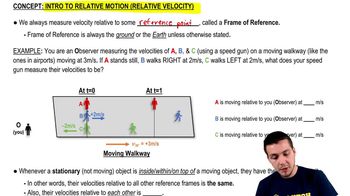
Intro to Relative Motion (Relative Velocity)

Speed of Light

The speed of light in a vacuum is a constant value, approximately 299,792,458 meters per second, and is denoted by 'c'. This speed is significant in physics as it sets a universal speed limit for the transmission of information and influences how we perceive time and space. When synchronizing clocks, the time it takes for light to travel from the origin to the clock's location must be considered to ensure accurate synchronization.
Recommended video:
Guided course
06:03
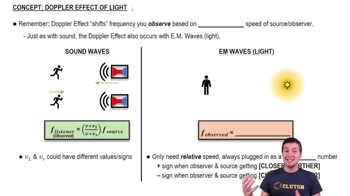
The Doppler Effect (Light)

Time Dilation

Time dilation is a phenomenon predicted by the theory of relativity, where time is observed to pass at different rates for observers in different frames of reference, particularly those moving relative to one another. This concept is essential when considering how time is measured in different locations, especially when high speeds are involved. In the context of the question, it emphasizes the importance of understanding how the relative motion of the observer and the clock can affect the perceived time at which the clock should be set.
Recommended video:
Guided course
12:57
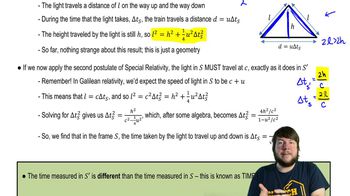
Time Dilation
Related Practice
Textbook Question

A cosmic ray travels 60 km through the earth's atmosphere in 400 μs, as measured by experimenters on the ground. How long does the journey take according to the cosmic ray?

70
views

Textbook Question

A newspaper delivery boy is riding his bicycle down the street at 5.0 m/s. He can throw a paper at a speed of 8.0 m/s. What is the paper's speed relative to the ground if he throws the paper (a) forward, (b) backward, and (c) to the side?

122
views
Textbook Question

An astronaut travels to a star system 4.5 ly away at a speed of 0.90c. Assume that the time needed to accelerate and decelerate is negligible. How long does the journey take according to Mission Control on earth?

60
views
Textbook Question

A baseball pitcher can throw a ball with a speed of 40 m/s. He is in the back of a pickup truck that is driving away from you. He throws the ball in your direction, and it floats toward you at a lazy 10 m/s. What is the speed of the truck?

107
views
Textbook Question

A firecracker explodes in reference frame S at t = 1.0 s. A second firecracker explodes at the same position at t = 3.0 s. In reference frame S', which moves in the x-direction at speed v, the first explosion is detected at x' = 4.0 m and the second at x' = -4.0 m. What is the speed of frame S' relative to frame S?

156
views
Textbook Question

Bjorn is standing at x = 600 m. Firecracker 1 explodes at the origin and firecracker 2 explodes at x = 900 m. The flashes from both explosions reach Bjorn's eye at t = 3.0 μs. At what time did each firecracker explode?

1312
views